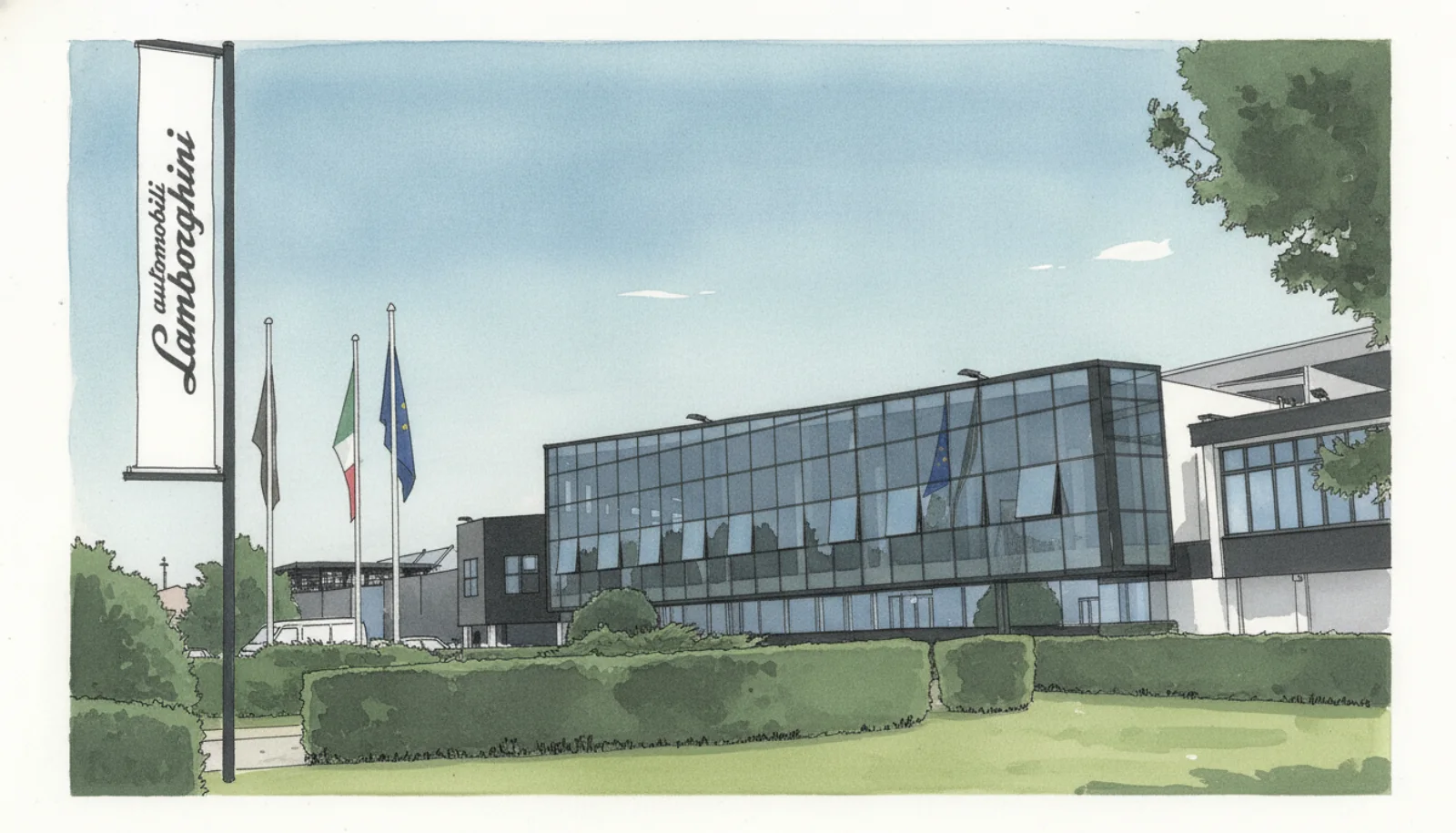
Ferruccio Lamborghini chose Sant'Agata Bolognese, near his home town of Cento, for his new car company in 1963. The first part of the factory went up in eight months over the autumn and winter of that year, and the press was invited to see the 350 GTV prototype on 20 October. The original works had 12,000 square metres under roof and two assembly lines. In the early years the plant assembled cars around bought-in bodies: Touring of Milan built and mated the 350 GT's bodies and chassis, Bertone bodied and trimmed the Espada, and Marazzi built the Islero's body. Lamborghini began making its own gearboxes and differentials in 1966 and added three more halls in 1968.
Output swung with the company's fortunes, from 425 cars in 1971 to 55 in 1979, recovering to 470 cars (plus 300 marine engines) in 1987. A composites department set up in 1983 built a carbon-fibre chassis prototype for the Countach Evoluzione, the start of the in-house carbon work that later produced the Aventador's monocoque. After Audi took over in 1998 the headquarters was rebuilt, with new assembly lines finished in August 2001. Not everything is made on site: the Huracán's chassis was assembled by Audi at Neckarsulm and the Urus's V8 comes from a Volkswagen plant in Hungary, with final assembly at Sant'Agata.
The Urus SUV changed the plant's scale. For its 2018 launch the site grew to about 160,000 square metres, with a dedicated Urus assembly line, a finishing department for every model, an office building and an SUV test track; a paint shop for Urus bodies followed in 2019, and since 2020 bodies arrive by rail. By 2022 the company delivered 9,233 cars and employed more than 2,000 people.
Opened
Still building
Today
- Status
- operating
- Models built
- 28
- Components
- 4
- Peak workforce
- Not documented
- Location
- 44.6589, 11.1261
- Also called
- Automobili Ferruccio Lamborghini works, Lamborghini Manifattura
Cars built here
- 1964–1966Lamborghini 350 GT · 120Bodies built by Touring of Milan (Superleggera); first chassis by Neri and Bonacini, then Marchesi. Chassis and bodies were mated at Touring and the cars completed at Sant'Agata. First car (No. 101) delivered to the factory 9 March 1964. Model article gives 120; Wikipedia's model list gives 118 including GTS and 3500 GTZ.
- 1966–1968Lamborghini 400 GT and 400 GT 2+2Wikipedia's model list gives 250 GT 2+2 plus a separate count of 23 for the 400 GT; it notes the figures do not add up.
- 1966–1973Lamborghini Miura (P400, P400 S, P400 SV) · 764Bertone design; assembled at Sant'Agata. Model article gives 1966–1973 (275 P400, 338 P400 S, 150 P400 SV); Wikipedia's model list gives 1966–1972.
- 1968–1978Lamborghini Espada · 1,217Chassis by Marchesi of Modena; bare chassis went to Bertone for bodywork, paint and trim before final assembly at Sant'Agata. Text gives 1,217, infobox 1,227.
- 1968–1969Lamborghini Islero and Islero S · 225Body built by Carrozzeria Marazzi; 125 Islero and 100 Islero S.
- 1970–1976Lamborghini Jarama and Jarama S · 327177 Jarama and 150 Jarama S per infobox; article text gives 328. Body builder not named in the sources consulted.
- 1972–1979Lamborghini Urraco (P200, P250, P300) · 791Model article infobox gives 1972–1979; Wikipedia's model list gives 1973–1979. P200 count is 66 in the table but 77 in the text.
- 1974–1990Lamborghini CountachSeries production began at Sant'Agata in March 1974; last car completed 4 July 1990 (see dossier). Totals by version are in the dossier.
- 1976–1979Lamborghini Silhouette · 55
- 1981–1988Lamborghini Jalpa · 410
- 1986–1993Lamborghini LM002 · 301Model article: assembled at Sant'Agata; 301 built, the last sixty as the US-only LM/American edition; end of production was announced in 1991 although the infobox runs to 1993. Wikipedia's model list gives 328 units.
- 1990–2001Lamborghini Diablo · 2,903Model article infobox gives 2,903 built; Wikipedia's model list total is lower.
- 2001–2010Lamborghini Murciélago · 4,099Infobox and text give 4,099; the article's production table sums to 3,983. The final SV run was cut short to make room for the Aventador line.
- 2003–2013Lamborghini Gallardo · 14,022
- 2008–2010Lamborghini Reventón (coupé and roadster) · 3620 coupés plus one for the museum, and 15 roadsters.
- 2011–2022Lamborghini Aventador (all versions)Built February 2011 to September 2022 at Sant'Agata, with an in-house carbon-fibre monocoque. The model article's sales table totals 11,831.
- 2012Lamborghini Sesto Elemento · 20
- 2013–2014Lamborghini Veneno (coupé and roadster)Wikipedia's model list: 2 prototypes, 3 coupés, 9 roadsters.
- 2014–2024Lamborghini Huracán (all versions)Chassis assembled by Audi at Neckarsulm, Germany, then shipped to Sant'Agata for final assembly.
- 2016–2017Lamborghini Centenario (coupé and roadster) · 40
- 2017–nowLamborghini UrusProduction began at Sant'Agata in 2017 (121 built that year) on a dedicated line; 10,000th in July 2020, 20,000 by 2022. Bodies are painted on site since 2019 and arrive by rail since 2020; where the body shells are made is not stated in the sources consulted. The V8 engine is assembled at a Volkswagen plant in Hungary.
- 2018–2023Lamborghini One-offs (SC18 Alston, SC20 Alston, Invencible, Auténtica) · 4
- 2020Lamborghini Sián FKP 37 (coupé and roadster) · 8263 coupés and 19 roadsters per Wikipedia's model list.
- 2020Lamborghini Essenza SCV12 · 40Track-only car.
- 2022Lamborghini Countach LPI 800-4 · 112
- 2023–nowLamborghini RevueltoFull production from July 2023.
- 2025–nowLamborghini Temerario
- 2025Lamborghini Fenomeno · 29
Parts made here
- Gearboxes and differentials · 1966–nowBrought in-house in 1966; later years not documented.
- Carbon-fibre composite structures · 1983–nowE.Co department from 1983 (first carbon chassis prototype, Countach Evoluzione); 'CFK – Lamborghini Carbon Production' established in 2011 with the Aventador's in-house carbon monocoque.
- Marine engines · 1987300 marine engines produced in 1987; other years not documented.
- Body painting (Urus paint shop) · 2019–nowPaint plant of more than 10,000 square metres announced 2017 and inaugurated 2019.
Pictures
Milestones
- 1963
First part of the factory built in eight months; the 350 GTV prototype shown to the press on 20 October.
- 1964
First 350 GT (No. 101) delivered to the factory on 9 March; first customer car on 31 July.
- 1965
67 cars produced.
- 1966
Gearbox and differential production brought in-house; the works then had 12,000 square metres under roof and two assembly lines.
- 1968
Three new industrial buildings announced on 18 October, adding 3,500 square metres and a test department.
- 1971
425 cars produced.
- 1974
Countach series production begins in March.
- 1979
Output falls to 55 cars.
- 1983
E.Co composites department starts carbon-fibre development.
- 1987
470 cars and 300 marine engines produced.
- 1990
Last Countach completed on 4 July; Diablo production begins.
- 1998
Lamborghini joins the Audi group.
- 2000
296 cars produced with 440 employees.
- 2001
EUR 155 million headquarters renovation completed; new assembly lines and canteen finished in August.
- 2003
Site of 100,000 square metres (28,900 covered); 1,305 cars and 624 employees.
- 2006
2,087 cars produced.
- 2008
11,000 square metre logistics platform opens in October.
- 2011
Aventador launched with an in-house carbon monocoque; CFK carbon production unit established.
- 2015
Trigeneration and district heating plants inaugurated; plant certified CO2-neutral.
- 2018
Urus introduced; covered area reaches 160,000 square metres with a dedicated Urus line, new finishing department, LEED Platinum offices and SUV test track.
- 2019
Urus paint plant inaugurated.
- 2020
Body deliveries switched from road to rail, cutting the related CO2 by 85 per cent; 10,000th Urus in July.
- 2022
9,233 cars delivered; more than 2,000 employees.
Sources
- Automobili Lamborghini factory and production turn 60 — Automotive World
- Automobili Lamborghini: Paint plant for the Urus SUV confirmed at Sant'Agata Bolognese — OneShift
- Lamborghini — Wikipedia
- List of Lamborghini automobiles — Wikipedia
- Museo Lamborghini — Wikipedia
- Lamborghini 350 GT — Wikipedia
- Lamborghini Miura — Wikipedia
- Lamborghini Espada — Wikipedia
- Lamborghini Islero — Wikipedia
- Lamborghini Jarama — Wikipedia
- Lamborghini Urraco — Wikipedia
- Lamborghini Jalpa — Wikipedia
- Lamborghini LM002 — Wikipedia
- Lamborghini Diablo — Wikipedia
- Lamborghini Murciélago — Wikipedia
- Lamborghini Gallardo — Wikipedia
- Lamborghini Aventador — Wikipedia
- Lamborghini Huracán — Wikipedia
- Lamborghini Urus — Wikipedia
- Lamborghini Revuelto — Wikipedia
- Coordinates are those of the Museo Lamborghini (English Wikipedia), which Lamborghini runs at Sant'Agata; that article does not itself state that the museum stands inside the factory compound, so treat the point as the company site rather than a specific assembly hall. No Wikipedia or Wikidata coordinate for the factory itself was found.
- Lamborghini's own history pages (lamborghini.com, media.lamborghini.com) redirected to the homepage for automated requests, so the 60-year factory timeline is taken from Automotive World's report of Lamborghini's anniversary release.
- workforcePeak: only company-wide figures were found (440 in 2000, 624 in 2003, 1,779 in December 2020 per Wikipedia, more than 2,000 in 2022). None is a documented plant peak, so the field is null.
- Area figures: OneShift (2017) says the site reached 150,000 square metres by end-2017 and would exceed 160,000 square metres of covered area with the paint shop; Automotive World describes the 2018 figure as 160,000 square metres covered. Third-party reports of an 80,000 to 160,000 doubling were seen only in search summaries and are not used.
- Unit conflicts: 350 GT 120 vs 118; Espada 1,217 vs 1,227; Jarama 327 vs 328; LM002 301 (model article) vs 328 (model list); Diablo, Murciélago and Gallardo totals in Wikipedia's model list are lower than the model articles. Model-article figures are used.
- Assembly at Sant'Agata is stated in the sources for the 350 GT, Miura, Espada, Islero, Jarama, Urraco, Jalpa, LM002, Diablo, Murciélago, Gallardo, Aventador, Huracán, Urus and Revuelto, and for the Countach in its dossier. For the 400 GT, Silhouette, Reventón, Sesto Elemento, Veneno, Centenario, Sián, Essenza SCV12, Countach LPI 800-4, Temerario, Fenomeno and the one-offs, the sources consulted give years and units but do not state the assembly site; they are listed because Sant'Agata is Lamborghini's only car factory in every source read, but the per-model assembly site is unverified.
- Body suppliers for the 400 GT, Jarama, Urraco, Silhouette and Jalpa are not named in the sources consulted. The Miura chassis maker (often said to be Marchesi) is not stated in the Miura article.
- Lamborghini Trattori is excluded: it is a separate company based at Pieve di Cento and has been separate from the car company since 1973.