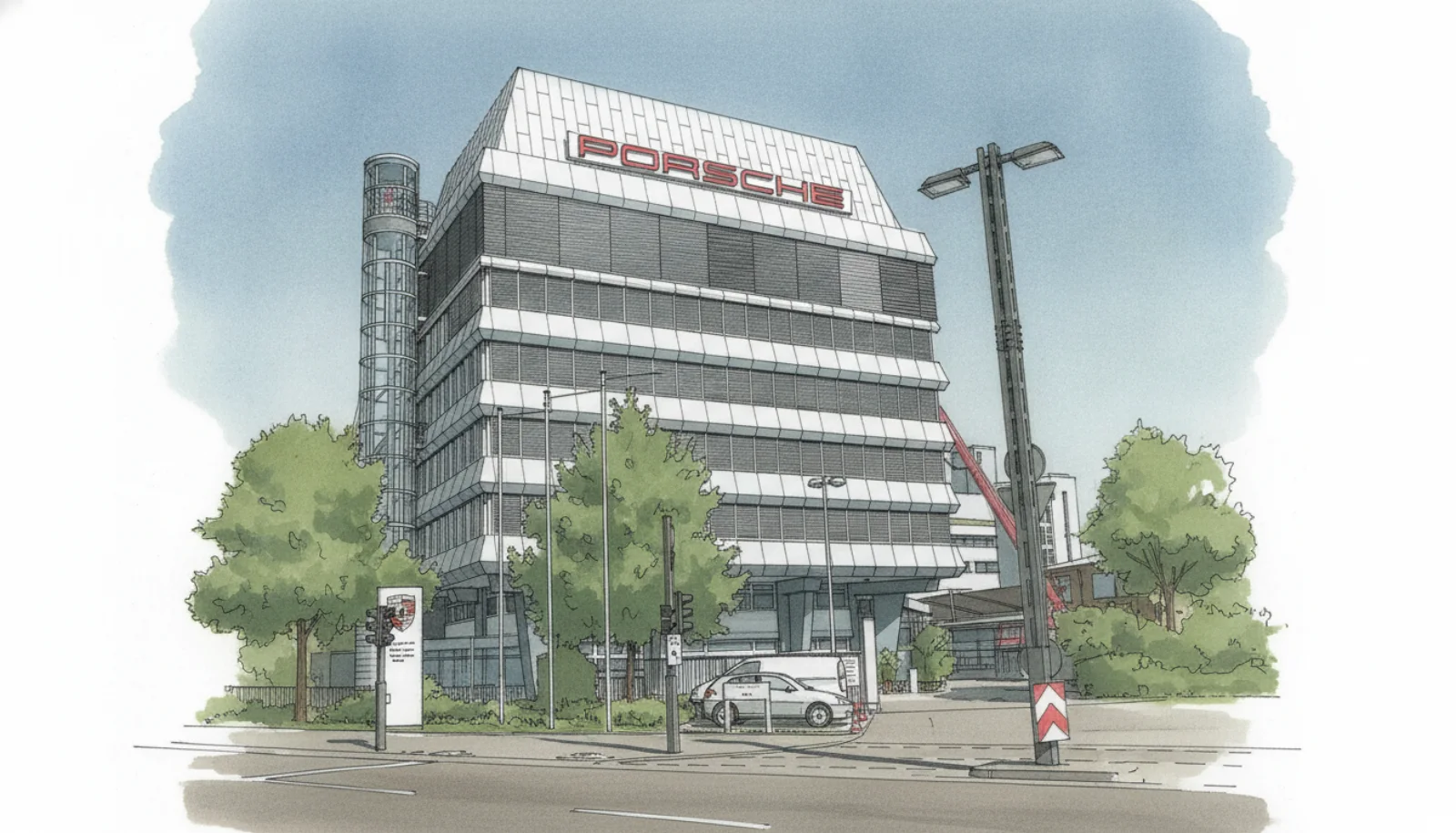
Porsche's engineering office moved to a new building at the corner of Spitalwaldstrasse and Schwieberdinger Strasse in Zuffenhausen in June 1938; that building is now Werk 1. The war took the company to Gmünd in Austria, where the first 52 cars of type 356 were built by hand in aluminium. When Porsche came back to Stuttgart the Allies were still occupying Werk 1, so it rented space in the neighbouring Reutter coachworks for engine work and assembly, and contracted Reutter to supply finished steel bodies. The first German-built 356 was completed on 6 April 1950.
Because the US military administration was slow to hand back Werk 1, Porsche had the architect Rolf Gutbrod design a new assembly hall, Werk 2, on land bought from Reutter; it opened in 1952 and was already being extended by 1954. Porsche moved back into Werk 1 in late 1955 for design, administration and racing development, while production stayed in Werk 2. Engine building began in Werk 3 in 1960, and on 1 December 1963 Porsche bought Reutter's body plant and its roughly 1,000 staff, bringing body manufacture in-house just as the 911 replaced the 356.
The site grew with the 911: a multi-storey final-assembly building (Building 41) opened in 1969, the front-engined 928 and later the 968 were built alongside the 911, and in 1988 Werk 5 opened as a body plant linked to final assembly in Werk 2 by a conveyor bridge over Schwieberdinger Strasse. The electric Taycan brought a new body shop, paint shop and assembly building from 2019. Today the complex builds the 911, Taycan and 718 and makes boxer and V8 engines and electric motors.
Opened
Still building
Today
- Status
- operating
- Models built
- 22
- Components
- 7
- Peak workforce
- Not documented
- Location
- 48.8345, 9.1519
- Also called
- Werk Zuffenhausen, Werk 1 / Werk 2 / Werk 3 / Werk 5 (individual sites within the complex), Karosseriewerk Reutter, Zuffenhausen (body plant, acquired 1963)
Cars built here
- 1950–1965Porsche 356 (356, 356 A, 356 B, 356 C) · 78,000Porsche Newsroom gives 'some 78,000' built at Zuffenhausen by the end of production in 1965 (approximate figure). Wikipedia gives about 76,000 for all 356s including roughly 50 from Gmünd. Steel bodies came mainly from Reutter.
- 1953–1956Porsche 550 Spyder · 90Wikipedia gives assembly only as 'Stuttgart'; no source opened names the Zuffenhausen works specifically.
- 1964–1989Porsche 911 (original series, including 911 SC and 3.2 Carrera)Calendar years. Porsche Newsroom says the first 911, still called 901, left the Zuffenhausen line in 1963; Wikipedia gives the start of series production as September 1964.
- 1965–1969Porsche 912Wikipedia gives assembly at Stuttgart-Zuffenhausen.
- 1970–1972Porsche 914/6 · 3,332Karmann built the rolling chassis and Porsche did final assembly. Wikipedia gives 3,332 in the infobox and 3,351 in the text; the 1970 start is inferred by Wikipedia's chassis table, not stated. The four-cylinder 914 was built by Karmann at Osnabrück.
- 1975–1989Porsche 911 Turbo (930) · 21,589Wikipedia: 2,819 3.0-litre (1975–1977) plus 18,770 3.3-litre (1978–1989).
- 1975–1976Porsche 912E · 2,099May 1975 to July 1976, US market only.
- 1977–1995Porsche 928 · 61,056May 1977 to 1995.
- 1982–1991Porsche 944Porsche Newsroom names the 944 among the front-engined models built at the site; Wikipedia gives assembly as Neckarsulm (Audi) and Stuttgart without dividing the run. How many 944s were built at Zuffenhausen is not documented in the sources read.
- 1989–1993Porsche 911 (964)Wikipedia gives assembly as Stuttgart; the 911 has always been built at Zuffenhausen (Porsche Newsroom).
- 1991–1995Porsche 968
- 1994–1998Porsche 911 (993)January 1994 to March 1998.
- 1996–2004Porsche Boxster (986)Also built by Valmet Automotive at Uusikaupunki, Finland.
- 1997–2006Porsche 911 (996)From 17 July 1997; Turbo S, GT2 and GT3 continued into 2005–2006.
- 2004–2012Porsche Boxster / Cayman (987)Boxster from September 2004, Cayman from August 2005; also built by Valmet at Uusikaupunki. Which bodies were built where is not split in the sources read.
- 2004–2013Porsche 911 (997)
- 2011–2019Porsche 911 (991)
- 2012–2016Porsche Boxster / Cayman (981)Also built at Osnabrück.
- 2013–2015Porsche 918 SpyderSeptember 2013 to June 2015.
- 2016–2025Porsche 718 Boxster / Cayman (982)Also built at Osnabrück. Wikipedia gives production 2016–2025; Porsche Newsroom (April 2025) still lists the 718 line at Zuffenhausen.
- 2019–nowPorsche 911 (992)
- 2019–nowPorsche Taycan
Parts made here
- Engine assembly in rented space at Reutter Plant II while Werk 1 was occupied · 1950–1952
- Engines (Werk 3) · 1960–nowEngine construction began in Werk 3 in 1960 (Porsche Newsroom). In 2025 two engine factories on the site make boxer engines for the sports cars, V8 engines for Porsche's four-door combustion models, and electric motors for the Taycan and Macan Electric.
- Car bodies (former Reutter body plant) · 1963–nowReutter built the painted, fully equipped 356 bodies at its Plant I on Augustenstrasse until 1953 (Porsche Newsroom); where Reutter built them from 1953 to 1963 is not stated in the sources read. Porsche bought the Reutter body plant on 1 December 1963.
- Body plant (Werk 5) with conveyor bridge to Werk 2 final assembly · 1988–nowA new Taycan body shop was added in Werk 5 for 2019.
- Paint shop (Werk 1, new for the Taycan) · 2019–now
- Interior saddlery (leather and trim)Porsche Newsroom says interior equipment is made in the factory's own saddlery; no start date given.
- Carbon-fibre exterior body parts (CFRP Manufaktur) for lightweight 911 models such as the 911 S/T and GT3 RSCurrent as of 2025; start date not given.
Pictures
Milestones
- 1937
November: cornerstone laid for Porsche's new headquarters at Spitalwaldstrasse and Schwieberdinger Strasse, designed by Richard Pfob.
- 1938
26 June: 176 employees move from central Stuttgart into the building that is now Werk 1.
- 1950
6 April: the first 356 built in Germany is completed; 317 cars are built by the end of the year.
- 1952
Werk 2, designed by Rolf Gutbrod on land bought from Reutter, starts operation.
- 1955
Late in the year Porsche moves back into Werk 1 for design, administration and racing development; production stays in Werk 2.
- 1960
Engine construction begins in Werk 3.
- 1963
The first 911 (then called 901) leaves the line; on 1 December Porsche buys the Reutter body plant with about 1,000 employees.
- 1964
September: series production of the 911 begins.
- 1965
356 production ends after some 78,000 cars at Zuffenhausen.
- 1969
Building 41 opens as a multi-storey final-assembly building.
- 1988
Werk 5 opens for body production, linked to Werk 2 by a conveyor bridge about 35 m above Schwieberdinger Strasse.
- 2019
Taycan series production begins with a new body shop in Werk 5, paint shop in Werk 1, assembly building at Werk 2 and a second conveyor bridge.
- 2025
Porsche marks 75 years of vehicle production at Zuffenhausen.
Sources
- Porsche has been manufacturing in Zuffenhausen for 75 years — Porsche Newsroom (Dr. Ing. h.c. F. Porsche AG)
- Groundbreaking of the Stuttgart-Zuffenhausen plant (first published in Christophorus 416) — Porsche Newsroom (Dr. Ing. h.c. F. Porsche AG)
- Porsche 356 — Wikipedia
- Porsche 550 — Wikipedia
- Porsche 911 (classic) — Wikipedia
- Porsche 912 — Wikipedia
- Porsche 914 — Wikipedia
- Porsche 911 (930) — Wikipedia
- Porsche 928 — Wikipedia
- Porsche 924 — Wikipedia
- Porsche 944 — Wikipedia
- Porsche 968 — Wikipedia
- Porsche 959 — Wikipedia
- Porsche 911 (964) — Wikipedia
- Porsche 911 (993) — Wikipedia
- Porsche 911 (996) — Wikipedia
- Porsche 911 (997) — Wikipedia
- Porsche 911 (991) — Wikipedia
- Porsche 911 (992) — Wikipedia
- Porsche Boxster (986) — Wikipedia
- Porsche Boxster and Cayman (987) — Wikipedia
- Porsche Boxster and Cayman (981) — Wikipedia
- Porsche 718 Boxster and Cayman (982) — Wikipedia
- Porsche 918 Spyder — Wikipedia
- Porsche Taycan — Wikipedia
- Porsche 904 — Wikipedia
- Porsche Museum (coordinates) — Wikipedia
- Commons file pages for the three plant photographs (licence and author fields) — Wikimedia Commons
- Coordinates are Wikipedia's for the Porsche Museum on Porscheplatz (48.83446, 9.15195), which stands at the Werk 1 / Werk 2 junction on Schwieberdinger Strasse (the Werk 2 photograph's Commons description places buildings 41K/41A on Porscheplatz). No source gives a separate coordinate for the factory itself.
- 'opened' is 1950, the first car built at Zuffenhausen. Werk 1 itself was occupied by Porsche's design office from June 1938.
- Werk 3 conflict: the 75-years release says engine construction began in Werk 3 in 1960; the groundbreaking article says the Werk 3 acquired in 1960 housed sales, customer service, the central spare-parts store and vehicle delivery. Both are Porsche Newsroom texts. The 75-years release also says engine construction was 'outsourced' in the 1960s without saying where to.
- Workforce: not documented as a peak. Figures found: about 1,000 Reutter employees joined in December 1963, bringing Porsche to about 2,000 (groundbreaking article); about 4,000 Porsche employees in 1973, more than double that across Zuffenhausen, Weissach and Ludwigsburg by the late 1980s (75-years release). None is a Zuffenhausen-only peak.
- Site area conflict: the 75-years release says about one square kilometre; the groundbreaking article says more than 600,000 square metres.
- Plant attribution by model: many Wikipedia infoboxes say only 'Stuttgart' (550, 964, 996, 997, 991, 968, 986, 982, Taycan). Porsche had no other Stuttgart car-assembly plant, and Porsche Newsroom says all 911 variants are built on one Zuffenhausen line and that the Taycan, 911 and 718 are built there, so these are listed. The 944 is listed on the Newsroom's word, with Wikipedia giving Neckarsulm and Stuttgart.
- Excluded: 924 (Wikipedia: Neckarsulm and Stuttgart; the Newsroom does not name it); 959 (Wikipedia: 'Stuttgart (Karosserie Baur)', i.e. the Baur coachworks, not shown to be Zuffenhausen); 904 (no assembly location in Wikipedia); 718 RSK and other racing cars (no source opened); Carrera GT, Cayenne, Panamera and Macan (Leipzig, per Porsche Newsroom).
- Karmann also built some 356 B bodies (the 1961–1962 'Karmann hardtop'); other outside body suppliers for the 356 and early 911/912 were not checked, so the 'Car bodies' entry does not claim Reutter/Porsche made every body.
- Exact unit totals by plant are not documented except the Newsroom's approximate 78,000 356s and 317 cars in 1950.