Model year
Generation
Brass radiator cars, 1909-1916
Built in 1909
Built in all, 1908–1927
Serial numbers, 1909
Engine numbers, calendar 1909310 → 14161
Price new, 1909
$825
United States
Origin
United States
Front-engine, rear-wheel drive
One chassis and one engine for nineteen years, built by the million and sold for as little as $260.
Economy car20 sources
How it launched in 1909
- 01Launch specification: 177 cu in four-cylinder engine cast in one block with a removable cylinder head, flywheel magneto, two-speed planetary transmission, 100 in wheelbase.
- 02Model year ran from October 1908 to 31 July 1909; engine number 1 was built on 28 September 1908 and the car shipped on 1 October.
- 03Body types: Touring, Runabout, Coupe, Town Car and Landaulet, with the Tourabout added from about June 1909 (announced at $850 for 1 August delivery).
- 04Roughly the first 750 cars had two pedals and two levers; the three-pedal layout then became standard.
- 05The first 2,500 engines had a gear-driven water pump and fan; the first thermo-syphon engine, number 2,448, was built on 22 April 1909.
- 06Colours on the first 2,500 cars: Touring red or green, Runabout gray, Coupe, Town Car and Landaulet green. From June 1909 red and gray were run out and every car was Brewster Green.
- 07Running boards changed from rubber-covered wood to pressed steel; hood changed from steel to aluminium during the year.
- 08Driveshaft with removable pinion from about car 7,000 (July); babbitt inner rear-axle bearings replaced by rollers from about car 12,000 (October).
- 09From 1 October 1909 gas headlamps, top, windshield and speedometer became standard on the open cars.
- 10Production figure is Ford's fiscal year, 1 October 1908 to 30 September 1909.
- 11Ford of Canada's own table lists 458 Model T under 1908.
Brass radiator cars, 1909-1916, 1908–1916
The first Model Ts had a brass radiator, a flat wooden firewall and bodies bought in from outside builders, at first all wood and from 1911 metal panels over a wood frame. The body was restyled in 1911, 1912, 1913 and 1914, and for 1915 gained a metal cowl, electric headlamps and two closed bodies, the centre-door Sedan and the Coupelet. Colour went from red, gray and green in 1909 to Brewster Green, then dark blue, then black from 1913. Annual output rose from 10,660 to 501,462 while the Touring fell from $850 to $360.
Built, this generation 1,315,843
Body styles by year
Trim lines and engines, 1909
| Line | Power | Torque | 0–60 mph | Top speed | Weight |
|---|---|---|---|---|---|
177 cu in L-head inline four, 3.75 in bore x 4.00 in stroke, cast en bloc with a removable cylinder head, splash lubrication, flywheel magneto and trembler-coil ignition | 20 hp | 83 lb-ft | — | 42 mph | — |
177 cu in L-head inline four, 3.75 in bore x 4.00 in stroke, cast en bloc with a removable cylinder head, splash lubrication, flywheel magneto and trembler-coil ignition | 20 hp | 83 lb-ft | — | 42 mph | — |
Model T, first 2,500 cars (water-pump engine)
1908–1909
- Engine
- 177 cu in L-head inline four, 3.75 in bore x 4.00 in stroke, cast en bloc with a removable cylinder head, splash lubrication, flywheel magneto and trembler-coil ignition
- Displacement
- 2,900 cc
- Layout
- I4 · naturally aspirated · RWD
- Power
- 20 hp (Ford's rating; fordmodelt.net gives 20-22 bhp at 1,600 rpm)
- Torque
- 83 lb-ft
- 0–60 mph
- Not documented
- Top speed
- 42 mph
- Weight
- Not documented
- Gearboxes
- 2-speed planetary with reverse, pedal operated
- Length × width × height
- 134 × — × — in
- Wheelbase
- 100 in
- Body styles
- Touring, Runabout (including the Torpedo and Open Runabouts of 1911-1912), Coupe, Town Car, Landaulet
- Price new
- Not documented
- Built
- 2,447
What this line added
- Gear-driven water pump and fan
- Two pedals and two levers on about the first 750 cars
- Oil side and tail lamps and bulb horn; top, windshield, gas headlamps and speedometer extra
Factory colors, 1909
3 of 15 documented colors were offered this year. Pick one to repaint the page.
Interiors, 1909
Units built by year
Touring, 1909
Runabout (including the Torpedo and Open Runabouts of 1911-1912), 1909
Landaulet, 1909
Town Car, 1909
Coupe, 1909
Left- and right-hand drive
The split is not documented.
US-built cars were left-hand drive from the start. Right-hand-drive cars were built for British buyers at Trafford Park and by Ford of Canada for Empire markets such as Australia, but no count of right-hand-drive production was found in the sources opened.
Sum of Ford's production records for fiscal 1909 to calendar 1927, covering cars, trucks and chassis from US plants and overseas assembly but excluding Canada. Ford's own data sheet gives 14,690,510. Ford of Canada records a further 757,888 Model T and TT. Ford marked the end of production with engine number 15,000,000 on 26 May 1927 and describes the total as more than 15,000,000.
Price when new
Lowest list price each year in United States, in USD of the day. Not adjusted for inflation.
Serial number ranges
| Series | Drive | Years | From | To |
|---|---|---|---|---|
| Engine numbers, calendar 1908Dated by sale, not manufacture. | — | 1908 | 1 | 309 |
| Engine numbers, calendar 1909Dated by sale. 1910 model year, from 1 August 1909, began at about 8,101. | — | 1909 | 310 | 14161 |
| Engine numbers, calendar 1910Dated by sale; approximate. 1910 model year about 8,101 to 31,500. | — | 1910 | 14162 | 34900 |
| Engine numbers, calendar 1911Dated by sale; approximate. Fiscal 1911 (to 30 September) about 31,500 to 70,750. | — | 1911 | 34901 | 88900 |
| Engine numbers, calendar 1912Fiscal 1912 was 69,877 to 157,424. No engines have been found numbered between about 158,000 and 169,000. | — | 1912 | 88901 | 183563 |
| B-series engines, October-December 1912Built at a separate Detroit plant and fitted in random order; they fill a gap of 12,247 numbers in the main series. | — | 1912 | B1 | B12247 |
| Engine numbers, calendar 1913Fiscal 1913 began at 157,425; 1914 model year began at about 348,736. | — | 1913 | 183564 | 408347 |
| Engine numbers, calendar 19141914 model year about 348,736 to 670,000. | — | 1914 | 408348 | 656063 |
| Engine numbers, calendar 19151915 model year about 670,000 to 856,513. | — | 1915 | 656064 | 1028313 |
| Engine numbers, calendar 19161916 fiscal and model year about 856,514 to 1,362,813. | — | 1916 | 1028314 | 1614516 |
| Ford of Canada engines (C prefix), 20 May 1913 to 31 July 1927Number reached: C-1500 on 31 July 1913, C-16500 July 1914, C-37500 July 1915, C-70000 July 1916, C-121000 July 1917, C-170000 July 1918, C-208500 July 1919, C-230611 on 31 December 1919, C-281419 December 1920, C-324394 December 1921, C-375735 December 1922, C-458188 December 1923, C-530621 December 1924, C-611588 December 1925, C-714988 December 1926. C-748010 is the last number in the record, not necessarily the last built: a 1927 coupe numbered C-748039 is recorded. Before May 1913 Canadian cars used engines bought from Ford in the US. | — | 1913–1927 | C1 | C748010 |
| Engine numbers, calendar 19171917 fiscal and model year about 1,362,814 to 2,113,501. | — | 1917 | 1614517 | 2449179 |
| Engine numbers, calendar 1918Fiscal 1918 about 2,113,502 to 2,756,251. | — | 1918 | 2449180 | 2831426 |
| Engine numbers, calendar 1919Fiscal 1919 (1 August 1918 to 31 July 1919) was 2,756,252 to 3,277,851. | — | 1919 | 2831427 | 3659971 |
| Engine numbers, calendar 1920Fiscal 1920 (to 31 July 1920) was 3,277,852 to 4,233,351. | — | 1920 | 3659972 | 4698419 |
| Engine numbers, calendar 1921No engines numbered in January 1921. Fiscal 1921 began at 4,233,352. | — | 1921 | 4698420 | 5638071 |
| Engine numbers, calendar 1922Fiscal 1922 ended on 31 July 1922. | — | 1922 | 5638072 | 6953071 |
| Engine numbers, calendar 1923Fiscal 1923 (to 31 July 1923) ended at 8,122,674; the high-radiator 1924 models follow from 8,122,675. | — | 1923 | 6953072 | 9008371 |
| Engine numbers, calendar 1924Fiscal 1924 (to 31 July 1924) ended at 10,266,471. From September 1924 Highland Park and River Rouge both numbered engines from separate blocks, so numbers and dates are out of sequence until February 1925. | — | 1924 | 9008372 | 10994033 |
| Engine numbers, calendar 19251925 model year ran to 12,218,728 on 27 July 1925, when the 1926 models began. | — | 1925 | 10994034 | 12990076 |
| Engine numbers, calendar 19261926 fiscal and model year was about 12,218,729 (27 July 1925) to 14,049,029 (31 July 1926). | — | 1926 | 12990077 | 14619254 |
| Engine numbers, 1 January to 31 May 1927Engine 15,000,000 was built on 26 May 1927, the last day of car production at Highland Park. The 1927 model year is given as 14,049,030 to about 15,006,625; Ford records give 15,007,032 as the last Model T. | — | 1927 | 14619255 | 15007032 |
| Engine numbers, June to December 1927 (engines built after US car production ended)Engine production continued until 4 August 1941 and ended at 15,176,888; 169,856 engines were built after the last car. | — | 1927 | 15007033 | 15076231 |
The car
The Model T went on sale in October 1908 as a $850 touring car with a 177 cubic inch four-cylinder engine, a two-speed planetary transmission worked by pedals, and a light, high-riding chassis on a 100 inch wheelbase. Ford made nothing else for the next nineteen years. The mechanical layout stayed essentially fixed while the body was restyled several times, most visibly for 1917, in August 1923 and for 1926.
Ford's own records count 14,689,520 cars, trucks and chassis built from fiscal 1909 to 1927, a figure that includes overseas assembly but not Canada, where a further 757,888 Model T and TT were made. Output grew from 10,660 in the first fiscal year to 2,011,125 in calendar 1923. As volume rose the price fell: the Touring was listed at $850 in 1909, $490 in 1914, $360 in 1916 and $290 in 1925, and the Runabout reached $260.
Early cars were red, gray or dark green, then dark blue. Black became standard in 1913 and was the only colour from the 1914 to 1925 model years. Colours returned on closed cars in 1926 and on every model from October 1926. An electric starter arrived in January 1919, standard on closed cars and a $75 option on open ones.
The car was assembled far beyond Detroit. Ford of Canada at Walkerville supplied Canada and most of the British Empire, Trafford Park in Manchester built British cars from October 1911, and assembly plants followed across Europe, Latin America, Australia, South Africa and Japan. Highland Park built engine 15,000,000 on 26 May 1927 and stopped; Cork built the last Model T that December.
- Class
- Economy car
- Layout
- Front-engine, rear-wheel drive
- Origin
- United States
- Designers
- Henry Ford, Childe Harold Wills, Joseph A. Galamb, Eugene Farkas
- Also known as
- Tin Lizzie
- In production
- 1908–1927
Milestones
- 1908
Engine number 1 built on 28 September; the first car shipped on 1 October at $850 for the Touring.
- 1909
First thermo-syphon engine, number 2,448, built on 22 April; all cars Brewster Green from June.
- 1910
Production moved from Piquette Avenue to the new Highland Park plant.
- 1911
First British-built Model T completed at Trafford Park, Manchester, on 23 October.
- 1913
Black became the standard colour; Canadian engine production began on 20 May; the moving assembly line started at Highland Park on 7 October.
- 1915
Electric headlamps, the centre-door Sedan and the Coupelet introduced.
- 1916
Black radiator shell, new hood and crowned fenders introduced in August as the 1917 model.
- 1919
Electric starter standard on closed cars from January, $75 extra on open cars.
- 1922
Fordor sedan introduced in December.
- 1923
Highest annual output, 2,011,125; higher radiator, Tudor Sedan and new Coupe introduced in August.
- 1925
Ford Motor Company of Australia formed and assembly set up at Geelong; the Improved Ford went into production on 27 July.
- 1926
Colours returned, first on closed cars and from 27 October on every model.
- 1927
Engine 15,000,000 built at Highland Park on 26 May, ending US car production; Trafford Park stopped in August and Cork built the last Model T in December.
- 1941
Last Model T engine assembled on 4 August, number 15,176,888.
Pictures
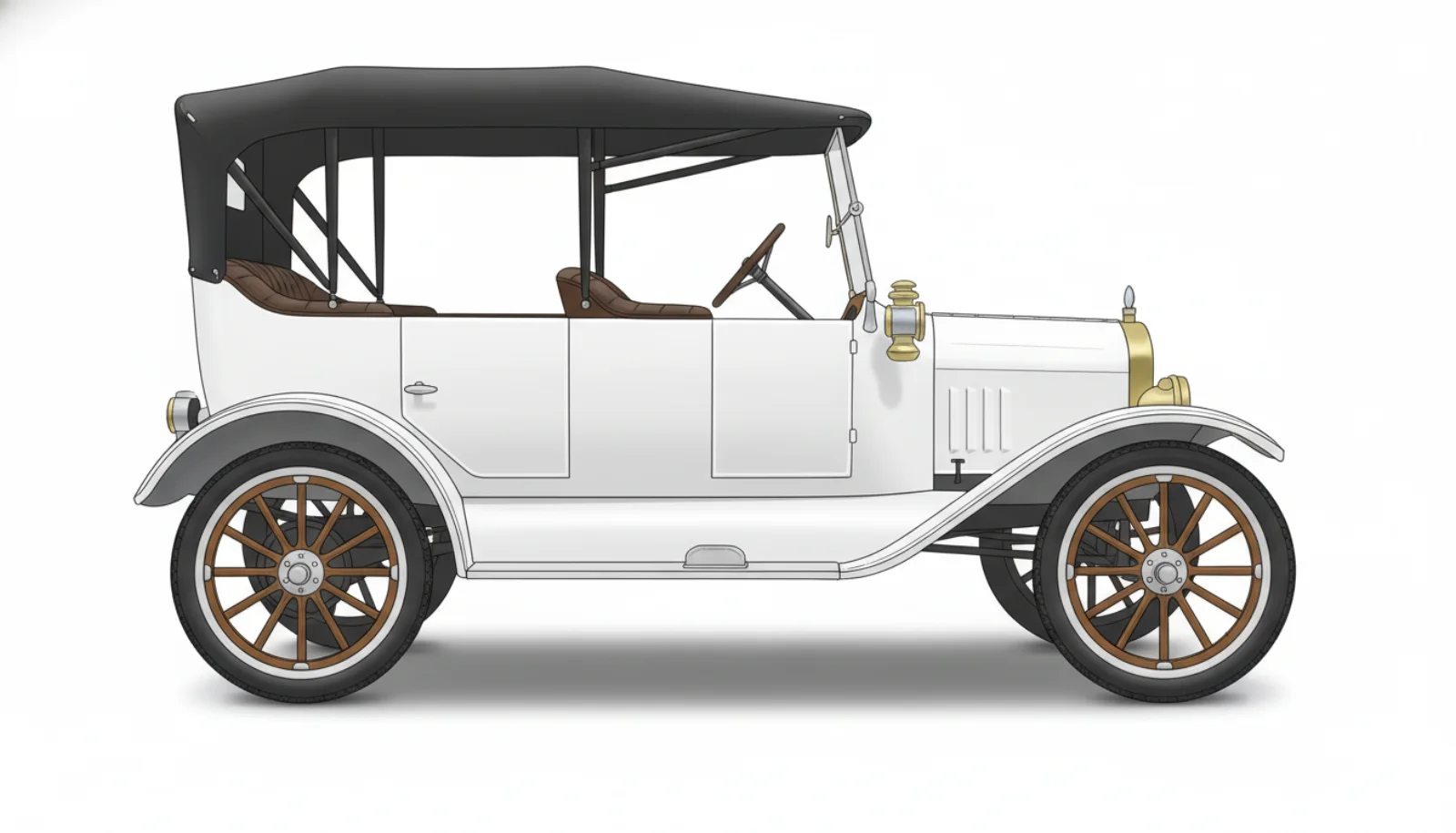
Illustrations are generated from period references and shown in the selected factory color; they are not photographs.
Where it was built
United States · 1908–1910
Piquette Avenue Plant
Detroit
The factory, what else it built →
United States · 1910–1927
Highland Park Plant (plus Ford branch assembly plants across the United States)
Highland Park
The factory, what else it built →
Canada
Ford Motor Company of Canada (757,888 Model T and TT built)
Walkerville
United Kingdom · 1911–1927
Trafford Park (more than 300,000 built, per Ford of Britain)
Manchester
Ireland
Ford Cork (last Model T built here, December 1927)
Cork
Australia · 1925–1927
Ford Motor Company of Australia
Geelong
Argentina
Ford assembly plant
Buenos Aires
Denmark
Ford assembly plant
Copenhagen
Germany
Ford assembly plant
Berlin
France
Ford assembly plant
Bordeaux
Spain
Ford assembly plant
Cadiz
Italy
Ford assembly plant
Trieste
Japan
Ford assembly plant
Yokohama
Mexico
Ford assembly plant
Mexico City
Chile
Ford assembly plant
Santiago
Norway
Ford assembly plant
Bergen
South Africa
Ford assembly plant
Port Elizabeth
Where the cars went
- Australia, 1908–1927: Round figure for all Model Ts sold in Australia, supplied as kits from Ford of Canada and assembled locally, at Geelong from 1925.
Against its rivals
Same class, same years. Each rival is shown in the specification and year a buyer would have cross-shopped.
Longer is better. Figures are for the variant and year named under each car, from the sources listed below.
In the comparison
Chevrolet Series 490 · 1915 · United States
Launched in June 1915 at $490 to undercut the Model T with a three-speed sliding-gear transmission and an overhead-valve engine.
Dodge 30-35 · 1914 · United States
Built by the brothers who had made Ford's engines and axles; a larger, 35 hp four with a three-speed gearbox for buyers moving up from a Ford.
Star Four · 1922 · United States
William Durant's assembled car, priced at $348 for a touring car in 1922 to match Ford directly.
Overland Four · 1919 · United States
Willys-Overland's light car, planned at $500 to challenge the Model T and launched in 1919 at $845 with electric lights and a starter.
Factory options
| Option | Code | Years | Price | Built with it |
|---|---|---|---|---|
| Top for the TouringExtra until top, windshield, gas headlamps and speedometer became standard on open cars on 1 October 1909. | — | 1908–1909 | $80 | — |
| Speedometer (Stewart Model 11)Ford Times, February 1909. The National and the Jones Model 21 were $30 each. | — | 1909 | $25 | — |
| Rear deck with rail for Runabout and TouraboutFlat wooden panel with a metal rail, shown in Ford Times, September 1909. | — | 1909–1910 | $9 | — |
| Electric starter and generatorOptional on open cars from 1919; standard on closed cars from January 1919. Added 95 lb. | — | 1919–1925 | $75 | — |
| Demountable rimsOptional on open cars; standard on closed cars. Added 55 lb. | — | 1919–1925 | $25 | — |
| 21 in balloon tyresOffered during 1925; the $25 figure is from a 1925 branch letter discussing the extra charge. | — | 1925 | $25 | — |
| Nickel-plated radiator shellOptional late in the 1925 model year and on open cars in 1926-1927; standard on closed cars from 1926. | — | 1925–1927 | — | — |
| Wire wheelsWelded wire wheels offered from about January 1926; black wire wheels standard on the Fordor from 27 October 1926 and later on other closed cars. | — | 1926–1927 | — | — |
| Coloured wire wheels in place of blackRecommended charge on the Fordor, Chicago branch letter, 28 October 1926. Straw, Casino Red and Emerald Green wheel paints are listed. | — | 1926–1927 | $10 | — |
| Stop lampOffered as an option for 1927. | — | 1927 | — | — |
| Body-colour hood (service part)Catalogue number 4050E, list price for any of nine colours, November 1926. | — | 1926–1927 | $8 | — |
| Kingston vaporizer carburettor (service part)Approved 30 March 1927; introductory price to dealers $4.50. | — | 1927 | $9 | — |
Known issues
Hand-crank kickback
1909–1927safetyCars without a starter are cranked by hand, and every car can be. If the spark lever is not fully retarded the engine can kick back through the crank and injure the hand, wrist or arm. Worn or badly adjusted transmission bands can also let the car creep forward onto the person cranking it.
Fix Retard the spark before cranking, set the hand brake, and cup the handle with the thumb on the same side as the fingers. The electric starter, standard on closed cars from January 1919, removed the need.
Braking limited to the transmission and two small rear drums
1909–1927safetyThe foot brake is a band acting on a drum in the transmission, so it works through the driveline; the hand lever works small drums on the rear wheels only. There are no front brakes. Owners' guides describe the arrangement as badly outdated, and a failure anywhere in the rear axle or driveshaft takes the foot brake with it.
Fix Ford enlarged the rear wheel brakes and widened the transmission drum for 1926. Owners commonly add accessory external rear wheel brakes worked from the brake pedal.
Babbitt thrust washers in the rear axle
majorFord used soft babbitt metal for the thrust washers that locate the differential. With age they crumble, the axle shafts shift and the ring gear can ride over the pinion, which damages the axle and removes drive and the foot brake together.
Fix Strip the rear axle and replace the original washers. Owners and specialists treat this as the first job on any car whose axle history is unknown.
Gravity fuel feed on steep hills
1909–1925moderateThe tank sits under the seat and feeds the carburettor by gravity, so on a steep climb with a low tank the fuel will not reach the engine. Australian accounts record steep hills being taken in reverse, which also gave a lower gear.
Fix Keep the tank full, or reverse up. For 1926 Ford moved the tank to the cowl on every model except the Fordor and the truck.
Weak rear body section on 1913 Touring
1913moderateThe Touring body introduced for 1913 flexed at the rear. Ford modified it during the year with heavier wood sills, extra support brackets and reinforcing plates.
Fix Later 1913 bodies carry the reinforcements; the 1914 body used a longer rear frame cross-member.
Dirt entering the engine through the throttle-rod opening
1909–1926minorThe throttle rod passed through the valve chamber, leaving a path for dirt into the engine. Ford's own files discuss the problem and a branch-made sealing device.
Fix A one-piece valve chamber cover without the hole was adopted on 2 October 1926.
Not suited to sustained modern road speeds
1909–1927minorOwners' guides put comfortable cruising at about 35 mph, with 40 mph hard on the engine, which limits the car to short trips on minor roads.
How it was advertised
Henry Ford regarded paid advertising as largely wasteful, and the Model T's advertising followed demand rather than a steady plan. The car was launched in October 1908 with a dense, technical full-page announcement in national weeklies such as Life, Collier's and the Saturday Evening Post, sold under the line "High Priced Quality in a Low Priced Car". From about 1911 to 1915 the company ran small, mostly text-only quarter-page notices built around the winged-pyramid "Ford: The Universal Car" logo and the price, since Ford sold only one model. The company dropped most national magazine space in 1914 and stopped buying advertising altogether in 1917.
From 1917 until 1923 the selling was left to dealers, who spent about $3 million a year, mostly in local newspapers, using logos, illustrations and copy supplied by the factory; importers and agents did the same abroad, in Argentina, Spain, the Netherlands and elsewhere. As Model T sales slipped in the early 1920s, Ford returned to national magazines in 1923 with a revived advertising department under Edsel Ford. The 1923–1927 campaign kept the "Universal Car" slogan but moved to colour illustration, styling and social standing, aimed several ads squarely at women, promoted the Ford Weekly Purchase Plan, and ran institutional pieces about Ford's factories. The Brotherton Company of Detroit is credited with at least one 1923 announcement.
Where it ran: 11 documented placements
The advertisements

The Ford Four Cylinder, Twenty Horse Power, Five Passenger Touring Car $850.00 Fob. Detroit
1908 · Life · 1908-10 · United States
The launch announcement: a Model T touring car drawn at the top under the line "High Priced Quality in a Low Priced Car", framed by an Art Nouveau border, above a long block of technical copy on the four-cylinder engine, vanadium steel, left-hand steering, light weight and the $850 price, signed from the Piquette Avenue plant in Detroit.

The Ford Four Cylinder, Twenty Horse Power, Five Passenger Touring Car $850.00 Fob. Detroit
1908 · Collier's · 1908-10-03 · United States
The same launch announcement as the Life version, scanned from Collier's: the touring car over a long technical argument for the car's vanadium steel, unit power plant and $850 price.

Two-page Model T advertisement
1909 · The Saturday Evening Post · 1909-08-14 · United States
A two-page spread from the Saturday Evening Post, photographed where it hangs at the California Automobile Museum.

Model T Souvenir Booklet (front cover)
1909 · United States
Cover of a 1909 Ford souvenir booklet showing a Model T touring car from the right, fitted with the optional folding top and headlamps.

Ford Motor Cars: 1911 (Torpedo Runabout page)
1911 · United States
Page 4 of Ford's 1911 full-line catalog, illustrating the low, rakish Torpedo Runabout body on the Model T chassis.

Russell Motor Car Company dealer ad for Ford Model T
1911 · Daily Picayune (New Orleans) · 1911-02-26 · United States
A local dealer's newspaper ad from Canal Street, New Orleans, picturing the Model T Touring Car and Torpedo Runabout: an early example of the dealer-placed advertising that carried the car when the factory pulled back.

La fábrica de automóviles más grande del mundo
1914 · La Esfera (Madrid) · Spain
Spanish-language ad from Ford's branch at Levallois-Perret near Paris: the winged "Universal Car" badge, a claim to be the world's largest car factory with more than half a million Fords on the road, four one-word virtues (simple, light, economical, solid) and a touring car, with agents throughout Spain.

Así hablan los hechos
1915 · Argentina
Ford Motor Co. Buenos Aires ad built around a news cable reported in La Prensa about a large wartime order of Ford cars, followed by an Argentine price list for the touring car, roadster, landaulet, coupelet and sedan, with a coupelet pictured.

Ford: The Universal Car
1916 · Netherlands
A spare two-colour notice from the Amsterdam general agency Handelsvereeniging "Ford": the script logo and slogan over a single Model T coupe in a ruled frame.

Ford Touring Car
1920 · Farmer's Magazine (Toronto) · Canada
Ford Motor Company of Canada ad: a pen drawing of a touring car parked at a mountain lookout among tall pines, with a framed panel claiming 190,000 satisfied owners in Canada.

Compare los materiales del Ford
1924 · El Sol (Madrid) · 1924-02-24 · Spain
Spanish newspaper ad pitched at the businessman: a pipe-smoking executive on the telephone beside a Model T sedan, urging readers to compare Ford materials and engineering, under the "automóvil universal" banner.

Y el problema se resolvió
1924 · La Vanguardia (Barcelona) · 1924-11-11 · Spain
Barcelona agents' ad: four men around a desk reaching a decision, with a Model T sedan below and the price of 7,880 pesetas delivered by rail to Barcelona.
More advertisements, viewable at their source (5)
These are still under copyright, so we describe them and link to where they can be seen rather than reproduce them.
- 1912Quarter-page "Universal Car" text advertisementmagazine · The Horseless Age · 1912-06-12 · The Henry Ford ↗A bordered, text-only quarter-page notice with the winged-pyramid Ford logo, typical of the small price-led ads Ford ran between 1911 and 1915.
- 1923Announcement: The New Ford Cars Are Now Ready for Your Inspectionmagazine · The Henry Ford ↗Full-page announcement of the restyled 1923 cars (lower bodies, taller radiator, more steeply raked windshield on open cars), among the first ads of Ford's return to national advertising after six years away.
- 1924How Did He Ever Get the Money to Buy a Car?magazine · The Henry Ford ↗Promotes the Ford Weekly Purchase Plan, under which buyers paid $5 a week into a bank until the price of a Model T was saved, citing more than 165,000 families who had used it.
- 1924Institutional ad featuring the Highland Park Plantmagazine · The Saturday Evening Post · 1924-07-12 · The Henry Ford ↗Rather than selling a car, this ad illustrated the Highland Park plant and presented Ford as the provider of low-cost transport for the country.
- 1925Woman driver and children at the shoremagazine · Ladies' Home Journal · 1925-07 · The Henry Ford ↗Children play in the sand while a woman drives: one of the mid-1920s ads that sold the Model T to women as their own way out of doors, still stressing cost and dependability.
The Henry Ford's article dates the launch ad to 1 October 1908 in Life and the Saturday Evening Post; the Commons scan of the same layout is from Collier's of 3 October 1908. The La Esfera ad's Commons file is named 1917-06-27 but its date field says 1914-06-27; the 1914 date is used here. Verify against the La Esfera issue before relying on it. The 1916 Dutch item's Commons page does not say where it was published, so its medium is given as other. No agency of record for the 1923–1927 national campaign was confirmed; only the Brotherton Company credit on the 1923 announcement was found. N. W. Ayer handled Ford later (a 1932 V-8 ad), but no source tied it to the Model T. The Henry Ford holds many more Model T ads in its Ford Motor Company Automobile Advertisements Series, but its pages give no open licence, so those are link-only. The 1920 Farmer's Magazine scan is marked "No known copyright restrictions" (Flickr Commons), not an explicit public-domain dedication; rights is set to public-domain on that basis.
Sources
- 1Production Years for Each Model T (production by body type and year, from Ford records as compiled by Bruce McCalley) — fordmodelt.net reference
- 2Ford Model T Serial Number Database (engine numbers by month, 1908-1941) — fordmodelt.net reference
- 3Canadian Ford Car Production, Model T and TT, and Canadian Model T and TT Ford Motor Numbers (Herman L. Smith, Historical Consultant, Ford Motor Company of Canada, January 1987), reproduced as page images — Ford Motor Company of Canada, via fordmodelt.net factory
- 4Ford Model T Original Prices (by body style and year) — fordmodelt.net reference
- 5Model T year-by-year reference pages, 1908-1927 (serial numbers, model year dates, body types, colours, components and dated factory changes citing Ford Times and Ford Archives accession 575) — fordmodelt.net reference
- 6Ford Model T Specifications — fordmodelt.net reference
- 7The Ford Model T in Australia — fordmodelt.net reference
- 8Replacing the Thrust Washers (Bryan Cady and Wayne Ashton) — fordmodelt.net club
- 9How to Drive a Ford Model T — fordmodelt.net club
- 10Buying Your First Ford Model T — fordmodelt.net club
- 11Ford Model T — Wikipedia reference
- 12The Model T — Ford Motor Company (corporate history) factory
- 13Ford Model T stars at London (Ford of Britain press release, 2008, archived copy) — Ford Motor Company factory
- 14Ford Trafford Park Factory — Wikipedia reference
- 15Ford: Model T — Grace's Guide to British Industrial History reference
- 161912 Ford Model T Touring, Walkerville-built car profile — conceptcarz.com reference
- 17Chevrolet Series 490 — Wikipedia reference
- 18Dodge 30-35 — Wikipedia reference
- 19Star (automobile) — Wikipedia reference
- 20Overland Automobile — Wikipedia reference
Research notes: what is not documented, and where sources disagree (15)
- The Model T Ford Club of America encyclopedia (mtfca.com), the usual first reference, sits behind a bot challenge and could not be opened. The year-by-year text, serial tables and production table used here were read on fordmodelt.net, which reproduces Bruce McCalley's Model T reference material. Web search ran out before the 1-, 5- and 10-millionth car dates could be documented, so they are left out of the milestones.
- Production is Ford's fiscal year through 1919 (to 30 September until 1913, a ten-month year to 31 July 1914, then 1 August to 31 July), then calendar years from 1921. The 1920 entry is seventeen months: fiscal 1920 (941,042) plus August to December 1920 (463,451). Model years, fiscal years and calendar years never line up, so units for a model year are the nearest reporting period, not cars of that specification.
- Year totals conflict between sources. Used here: 1909 10,660, 1912 68,773 and 1925 1,911,706, which are the sums of the body-type rows. Wikipedia prints 10,666, 68,733 and 1,911,705. Ford's data sheet shows 19,051 for 1910, 69,762 for 1912 and a grand total of 14,690,510 against the summed 14,689,520. The 1923 body-type rows sum to 2,011,105 against the printed 2,011,125.
- Body-style units are starter and non-starter rows added together, and generation totals are the year figures added together; both are arithmetic on the source table, not separately published figures. The source table carries no truck figure for fiscal 1920, so its rows for that year do not reach the printed total. Runabout figures include Torpedo and Open Runabouts. The 1915-1917 figures in the source's Coupe row are entered as Coupelets, the only such body offered. Tourabout production is not recorded; sales records show 929 sold in 1909-1911.
- The calendar 1923 sedan figure (89,535) mixes the last centre-door Sedans with the first Tudor Sedans, built from August 1923. The source's totals row files all starter-equipped centre-door Sedans of 1919-1923 under Tudor.
- Engine numbers before 1913 are dated by sale, not manufacture. The serial table and the year pages on the same site disagree in places: 1919 starts at 2,831,427 on the year page and 2,843,127 in the table (the year page figure is used because it follows 1918's last number); the end of 1921 is 5,638,071 in the table and 5,568,071 on the year page; the end of fiscal 1921 is 5,337,545 or 5,377,545 and of fiscal 1922 6,334,196 or 6,344,196. The 1927 page also prints a garbled range (15,626,006 to 15,007,032) for late May 1927.
- Prices are the figures in the fordmodelt.net table, which does not state the equipment included. The 1923 figures are higher than both 1922 and 1924, which suggests the basis changed for that row (possibly starter-equipped cars); this could not be confirmed. Three entries in that table were left out as probable errors: a $750 Coupe for 1914, when no Coupe was offered, a $1,590 Coupelet for 1915, and a Tudor price for 1923 that predates the Tudor. Wikipedia gives the Runabout as $500 for 1917, where the table gives $345 for 1917 and $500 for 1918.
- Canada: Ford of Canada's 1987 summary gives production by its own year (1908: 458; 1909-10: 1,280; 1910-11: 2,805; 1911-12: 6,388; 1912-13: 11,584; 1913-14: 15,657; 1914-15: 18,771; 1915-16: 32,646; 1916-17: 50,043; 1917-18: 46,914; 1918-19: 39,112; 1919-20: 55,616; five months of 1920: 15,626; 1921: 42,349; 1922: 50,266; 1923: 79,115; 1924: 71,726; 1925: 79,244; 1926: 100,611; 1927: 37,677; total 757,888, Model T and TT together). conceptcarz attributes the 11,584 figure to 1912. The same document says it can account for 15,900,312 Model T engines worldwide. Its colour list for Canadian cars differs from the US one: blue for 1911-1915, blue-green for 1916-1918 and black from 1919.
- United Kingdom: a Ford of Britain press release says more than 300,000 cars were built at Trafford Park before Model T production ended there in August 1927. A search result attributed a figure of 150,000 to Grace's Guide, but the Grace's Guide page opened gives no total. Annual UK figures found: 3,000 in 1912, 6,000 in 1913 and a 10,000 target for 1914. By 1924 Trafford Park cars had 94% British content and sold for about 135 pounds. No UK production by year and no right-hand-drive count was found.
- The Dossier type has no field for production by country, so the Canadian and British totals are carried in the assembly plant names, the model-year change lists and these notes. The markets array holds only Australia, the one country with a sales figure. Other overseas assembly cities are as listed by Wikipedia, without dates or counts. Wikipedia also lists Sao Bernardo do Campo in Brazil, Asnieres-sur-Seine, Barcelona, further Australian and Canadian branch cities and more than thirty US branch plants; these are not itemised here.
- Seat counts are required by the schema but are documented only for the Fordor (a five-passenger sedan in Ford's 1922 announcement) and the Coupe (two passengers). The others follow the usual capacity of the body type, and the Town Car and Landaulet figure of six in particular is unverified and should be checked. Door counts for the Touring, Runabout, Coupe and sedans are from Wikipedia; the Touring had two doors until 1911, the Runabout none.
- No kerb weight by body style was found; Wikipedia gives a range of 1,200 to 1,650 lb and fordmodelt.net 1,200 to 1,500 lb, so weight is null. Top speed is Wikipedia's 42 mph; fordmodelt.net says about 45 mph. Torque (83 lb-ft at 900 rpm) and the 20-22 bhp figure are from fordmodelt.net's specification page, which names no source. Displacement is entered as the source's rounded 2,900 cc. Width and height are Wikipedia's figures for a 1912 roadster.
- The first car is dated differently by source: Wikipedia says the first production car was built on 12 August 1908 and left the factory on 27 September; the Ford Archives entries quoted on fordmodelt.net give engine number 1 on 28 September and shipment on 1 October, which Ford's corporate history also uses.
- Colour names and codes for 1926-1927 come from branch and factory letters quoted in the 1926 and 1927 pages. Two code series appear for the same colours (M601-M608 in the Chicago letter of 27 October 1926, M-630 to M-637 in the paint list of 12 November 1926). No colour had production counts. Hex values are screen approximations.
- Rivals carry few figures because the Wikipedia pages for them give little: no torque, top speed or weight for any, and no price for the Dodge.
20 sources. Paint swatches are screen approximations of the factory colors.