McLarenF1
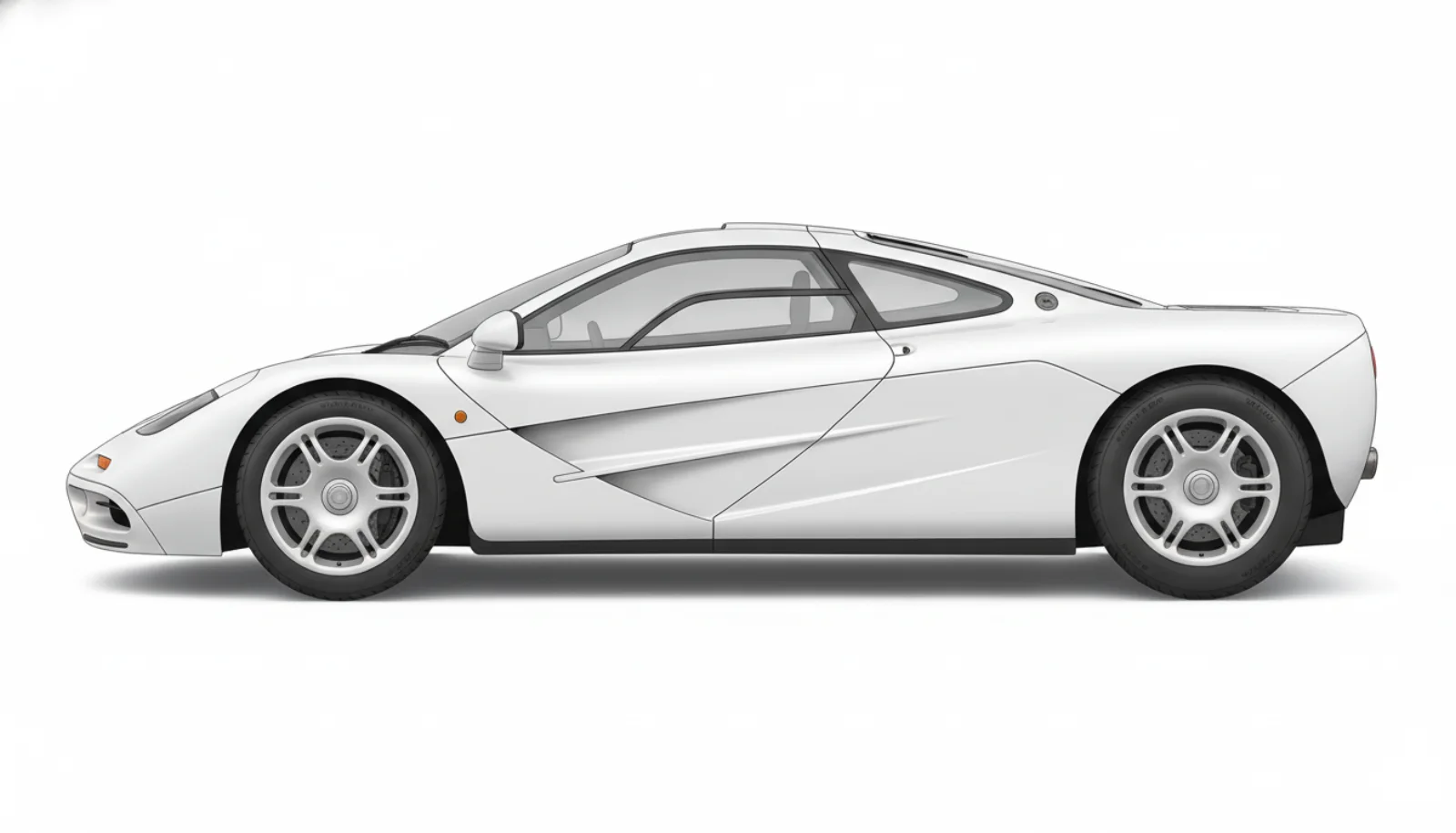
Mercedes-Benz Brilliant Silver · 1993–1998not offered in 1992
Screen approximation of the factory paint
Model year
Generation
F1 (1992–1998)
Built in 1992
Not documented
Built in all, 1992–1998
Serial numbers, 1992
PrototypesXP1 → XP5
Price new, 1992
Not documented
Origin
United Kingdom
Mid-engine, rear-wheel drive, central driving position
A three-seat, carbon-monocoque road car with a central driving position and a BMW Motorsport V12, built in 106 examples at Woking between 1993 and 1998.
Supercar39 sources
How it launched in 1992
- 01Clinic model unveiled on 28 May 1992 at the Sporting Club, Monaco, during the Grand Prix weekend.
- 02The BMW engine had been ready since late 1991.
- 03First running prototype, XP1 (black), started for the first time on 23 December 1992.
- 04No production cars completed.
F1 (1992–1998), 1992–1998
One model run from the 1992 Monaco unveiling to the last road car in May 1998. Road cars carry three-digit chassis numbers from 002 to 075 (64 cars; numbers 54, 56 and 58 went to the F1 GTs). The prototypes are XP1 to XP5 plus XP LM and XP GT, the customer LMs are LM1 to LM5, and the racing GTRs are numbered with an R suffix from 01R to 28R. The 17-character VIN begins SA9AB5AC and ends with the chassis number, for example SA9AB5AC4R1048014 for chassis 014.
Built, this generation 106
Body styles by year
Trim lines and engines, 1992
| Line | Power | Torque | 0–60 mph | Top speed | Weight |
|---|---|---|---|---|---|
6,064 cc BMW S70/2 60° V12 | — | — | — | — | — |
XP1–XP5 prototypes
1992–1994
- Engine
- 6,064 cc BMW S70/2 60° V12
- Displacement
- 6,064 cc
- Layout
- V12 · naturally aspirated · RWD
- Power
- Not documented
- Torque
- Not documented
- 0–60 mph
- Not documented
- Top speed
- Not documented
- Weight
- Not documented
- Gearboxes
- 6-speed manual
- Length × width × height
- Not documented
- Wheelbase
- Not documented
- Body styles
- Three-seat coupé with dihedral doors (road car, prototypes, LM)
- Price new
- Not documented
- Built
- 5
What this line added
- XP1: black; about 6,000 hours to build; first started 23 December 1992; weighed 1,003 kg; destroyed by fire after rolling at about 150 mph during hot-weather testing in Namibia on 24 March 1993.
- XP2: bright blue; delivered to MIRA in Warwickshire in the second week of December 1993 for the 30 mph type-approval crash test; the steering column moved 14 mm against a 127 mm limit and the monocoque was undamaged.
- XP3: silver; endurance testing in 1993 with Mika Häkkinen and Jonathan Palmer; 231 mph at Nardò with Palmer; later passed to Gordon Murray.
- XP4: shared XP2/XP3's small front indicators and single tail lights; later history disputed.
- XP5: Dark Metallic Green; registered K8 MCL April 1994; the Autocar road-test car in May 1994 and the 1998 Ehra-Lessien record car; kept by McLaren.
Factory colors, 1992
0 of 22 documented colors were offered this year. Pick one to repaint the page.
Interiors, 1992
Units built by year
Left- and right-hand drive
The split is not documented.
Not applicable in the usual sense: every F1 has a central driving position. The road cars were built with the same layout whatever the market.
64 road cars, 28 GTRs, 5 customer LMs, 2 customer GTs and 7 prototypes (XP1 to XP5, XP LM, XP GT), as broken down by RM Sotheby's.
Serial number ranges
| Series | Drive | Years | From | To |
|---|---|---|---|---|
| Road cars (64)First production car 002 (December 1993), last 075 (May 1998). Numbers 054, 056 and 058 were used by the F1 GTs. Chassis 001 is documented by an online registry as a silver car shown in 1994; its status is unclear. | — | 1993–1998 | 002 | 075 |
| VIN example, chassis 014 | — | 1994 | SA9AB5AC4R1048014 | … |
| VIN example, chassis 018 | — | 1994 | SA9AB5AC1R1048018 | … |
| Prototypes | — | 1992–1994 | XP1 | XP5 |
| F1 LMPrototype XP LM, then customer cars LM1 to LM5. | — | 1995–1996 | XP LM | LM5 |
| F1 GTThree cars: 56 XP GT, 54 and 58. | — | 1997 | 56 XP GT | 58 |
| GTR, 1995 specification | — | 1995 | 01R | 09R |
| GTR, 1996 specification10R was the 1996 show car; the last 1996 number is not confirmed in a source opened (19R was the first 1997 car). | — | 1996 | 10R | … |
| GTR, 1997 long tail | — | 1997 | 19R | 28R |
The car
The F1 was McLaren's first road car, conceived by Gordon Murray after the 1988 Italian Grand Prix and approved by Ron Dennis in 1989. It was shown as a clinic model at the Sporting Club in Monaco on 28 May 1992, the first running prototype (XP1) started on 23 December 1992, and the first production car, chassis 002, was finished in December 1993. The driver sits in the middle, slightly ahead of two passenger seats, and gets in through dihedral doors.
The structure is a carbon-fibre monocoque, and the engine is a 6,064 cc, 60-degree, 48-valve V12 (type S70/2) designed by BMW Motorsport under Paul Rosche, mounted as a stressed member and driving the rear wheels through a transverse six-speed manual gearbox. Gold foil lines the engine bay as heat insulation. Standard equipment included air conditioning, a Kenwood CD stereo, fitted luggage and a Facom titanium tool kit.
McLaren had planned on several hundred cars but built 64 road cars, the last of them (chassis 075) in May 1998. Around them it built five XP prototypes, six LMs (the XP LM and LM1 to LM5), three long-tail F1 GTs and 28 GTR racing cars, 106 cars in all. A GTR won the 1995 24 Hours of Le Mans outright at the model's first attempt, and on 31 March 1998 Andy Wallace drove prototype XP5 to a two-way average of 240.1 mph at Ehra-Lessien with the rev limiter raised.
Every road car has its own documented specification, and most of the original colours are recorded only car by car. Running costs are high: the fuel cell has a five-year life whether or not the car is used, and McLaren still supports the cars directly.
- Class
- Supercar
- Layout
- Mid-engine, rear-wheel drive, central driving position
- Origin
- United Kingdom
- Designers
- Gordon Murray (technical director, lead designer), Peter Stevens (styling), Paul Rosche (BMW Motorsport, S70/2 engine)
- Also known as
- McLaren F1 LM, McLaren F1 GT, McLaren F1 GTR
- In production
- 1992–1998
Milestones
- 1988
Gordon Murray proposes the road car after the Italian Grand Prix in September.
- 1992
Unveiled on 28 May at the Sporting Club, Monaco; XP1 first runs on 23 December.
- 1993
XP1 destroyed in Namibia on 24 March; XP3 reaches 231 mph at Nardò; first production car 002 completed in December.
- 1994
Autocar tests XP5 (0–60 mph 3.2 s); 25 road cars completed, the most of any year.
- 1995
GTR 01R wins the 24 Hours of Le Mans outright on 18 June at the model's first attempt; McLaren wins 10 of 12 BPR rounds.
- 1996
Five customer F1 LMs built; GTRs win the BPR and JGTC titles.
- 1997
Three F1 GTs and ten long-tail GTRs built; the Gulf GTR finishes second overall at Le Mans, a lap behind the winner.
- 1998
Andy Wallace averages 240.1 mph in XP5 at Ehra-Lessien on 31 March; the last road car, 075, is completed in May.
Pictures
Illustrations are generated from period references and shown in the selected factory color; they are not photographs.
Where it was built
Where the cars went
- Brunei: All types: ordered by the Brunei Royal Family: five road cars, three F1 LMs, one GTR (a replica of the 1995 Le Mans winner) and one F1 GT (chassis 54).
- United Kingdom, 2022: Where cars were located in 2022 per Hagerty's analysis as reported by The Drive; 22 of the 40 are race cars. The Drive's table sums to 104, not the 100 survivors it states.
- United States, 2022: Hagerty via The Drive; 5 race cars.
- Bahrain, 2022: Hagerty via The Drive.
- Brunei, 2022: Hagerty via The Drive; 3 road, 4 race.
- Germany, 2022: Hagerty via The Drive.
- Japan, 2022: Hagerty via The Drive.
- Switzerland, 2022: Hagerty via The Drive.
- Hong Kong SAR China, 2022: Hagerty via The Drive.
- Mexico, 2022: Hagerty via The Drive.
- New Zealand, 2022: Hagerty via The Drive.
- Australia, 2022: Hagerty via The Drive.
- Singapore, 2022: Hagerty via The Drive.
Against its rivals
Same class, same years. Each rival is shown in the specification and year a buyer would have cross-shopped.
Longer is better. Figures are for the variant and year named under each car, from the sources listed below.
In the comparison
Jaguar XJ220 · 1992 · United Kingdom
The other British supercar of the early 1990s and the previous production speed record holder; 0–60 and top speed are Road & Track's measured figures.
Bugatti EB110 GT · 1992 · Italy
Contemporary carbon-chassis V12 supercar; 0–60 measured by Autocar, March 1994; top speed is the factory figure; 139 built across GT and SS.
Ferrari F50 · 1995 · Italy
Ferrari's mid-1990s V12 flagship; 0–60 from Car and Driver, January 1997; top speed is Ferrari's claim.
Porsche 911 GT1 Straßenversion · 1997 · Germany
Road homologation version of the GT1 racer that beat the F1 GTR at Le Mans; top speed 308 km/h measured by Auto, Motor und Sport in 1997. About 20 road cars built (Wikipedia gives an approximate figure only).
Factory options
| Option | Code | Years | Price | Built with it |
|---|---|---|---|---|
| High Downforce Kit (HDK)GTR-inspired factory conversion: body kit, 18-inch GTR wheels and uprated suspension, offered from mid-production. RM Sotheby's calls chassis 014 the last of eight cars to get it; Wikipedia's variant table lists two HDK cars. Chassis 069 was converted in 1999. | — | 1994–1999 | — | — |
| LM-specification conversion with Extra-High Downforce KitFactory conversion of road cars 018 and 073 to LM specification. | — | — | — | 2 |
| GTR 1996 upgrade pack (for 1995 GTRs)Brought 1995-specification GTRs to 1996 specification. | — | 1996 | £148,000 | — |
Known issues
Fuel cell must be replaced every five years
1993–1998majorThe F1 uses a flexible fuel bag (cell) rather than a tank, and it has a five-year life whatever the mileage. Gordon Murray himself later called the bag a mistake because of this. Replacing it is a large job.
Fix Replacement through McLaren; chassis 014 had its cell replaced during a 2018 engine-out service, and chassis 007 received a new alloy fuel cell in August 2022.
Clutch needs frequent adjustment
1993–1998moderateThe carbon clutch needs regular adjustment, in some cars after as little as 5,000 miles.
Running costs
1993–1998moderateMcLaren estimated annual running costs at $30,000 (The Drive). One owner reported a $50,000 bill for a tyre change including on-car balancing, suspension adjustment and track time, and about $50,000 a year to keep a car even when unused. Chassis 014 had more than $50,000 of maintenance during its 2018 engine-out service.
Fix Servicing is done by McLaren and its authorised F1 service centres (eight worldwide per Wikipedia); each car has a modem for remote ECU data download.
Weak air conditioning and headlamps
1993–1998minorThe air conditioning struggles because of poor air extraction and a compressor not suited to the engine's rev range. The bought-in headlamps are poor; Murray judged the car unsafe above about 100 mph in the dark.
Fix Some cars, such as 069, received a newer air-conditioning system during factory upgrades.
Brakes and steering criticised
1993–1998minorPeriod testers found the unassisted steel brakes only adequate for the speed and the pads prone to squeal; the unassisted steering is heavy and the gate of the gearchange narrow.
How it was advertised
McLaren did not advertise the F1 in any conventional way. Only 106 cars were built between 1992 and 1998, following the car's unveiling at The Sporting Club in Monaco on 28 May 1992. Its reputation was made by the motoring press (Autocar's 1994 road test called it the finest driving machine yet built for the public road), by the racing F1 GTR's win at the 1995 Le Mans 24 Hours, with GTRs also third, fourth, fifth and thirteenth, and by the 240.1 mph two-way production-car speed record set by the XP5 publicity car, driven by Andy Wallace at Ehra-Lessien on 31 March 1998.
The only sustained print advertising featuring the car was a supplier's: Kenwood, which developed the F1's audio system, used the car in its own print ads, calendars and brochure covers from 1992 to 1998. No McLaren advertising agency, magazine campaign or television advertising for the F1 was found.
Where it ran: 2 documented placements
More advertisements, viewable at their source (2)
These are still under copyright, so we describe them and link to where they can be seen rather than reproduce them.
- 1992McLaren F1 unveiled in Monacoother · 1992-05-28 · Wikipedia ↗The car's public unveiling at The Sporting Club in Monaco, which with the press road tests that followed did the work an advertising launch would normally do.
- 1998240.1 mph production-car speed record (XP5)other · 1998-03-31 · Wikipedia ↗Andy Wallace's two-way 240.1 mph run at Volkswagen's Ehra-Lessien track in XP5, a car McLaren kept for publicity; a promotional event rather than an advertisement.
The McLaren F1 was barely advertised, and saying so is the finding. No McLaren print or broadcast advertisement for the car was found on Wikimedia Commons, in the AHPS library or in the Internet Archive collections checked. Kenwood's 1992–1998 ads featuring the F1 are documented only in general terms by Wikipedia; no individual Kenwood ad with a date and publication was located, so none is listed. The web-search budget for this run ran out before these and any factory brochure could be traced. Wikipedia gives no launch price; it is omitted.
Sources
- 1McLaren F1 — Wikipedia reference
- 2Guide: The New Standard – a Historical & Technical Appraisal of the McLaren F1 — Supercar Nostalgia reference
- 3McLaren F1 chassis histories (VIN series, tag listing pages 1–3) — Supercar Nostalgia registry
- 4VIN: the Sultan of Brunei McLaren F1 chassis 004 — Supercar Nostalgia registry
- 5VIN: Up & Running – the original McLaren F1 Prototype chassis XP1 — Supercar Nostalgia registry
- 6VIN: Gordon Murray's McLaren F1 Prototype chassis XP3 — Supercar Nostalgia registry
- 7VIN: the World Speed Record-setting McLaren F1 Prototype chassis XP5 — Supercar Nostalgia registry
- 8Guide: the F1 Goes Homologation Special – McLaren F1 LM — Supercar Nostalgia reference
- 9Guide: Final Fight – a Historical & Technical Appraisal of the McLaren F1 GT — Supercar Nostalgia reference
- 10VIN: the Yoshio Tsuzuki McLaren F1 GT chassis 58 — Supercar Nostalgia registry
- 11Guide: Take it to the Track – McLaren F1 GTR 95 — Supercar Nostalgia reference
- 12Guide: Retaining the Advantage – McLaren F1 GTR 96 — Supercar Nostalgia reference
- 13VIN: McLaren F1 GTR chassis 19R — Supercar Nostalgia registry
- 14VIN: the Ron Dennis McLaren F1 chassis 003 — Supercar Nostalgia registry
- 15VIN: the Ben Pon Jr. / Jay Leno McLaren F1 chassis 015 — Supercar Nostalgia registry
- 16VIN: McLaren F1 chassis 029 — Supercar Nostalgia registry
- 17VIN: the Yoshio Tsuzuki McLaren F1 chassis 053 — Supercar Nostalgia registry
- 18VIN: 1 of 1 Dandelion Yellow Art Sports McLaren F1 chassis 060 — Supercar Nostalgia registry
- 19One to Buy: ex-Rowan Atkinson 1997 McLaren F1 (chassis 061) — Supercar Nostalgia registry
- 20VIN: the James Munroe McLaren F1 chassis 069 — Supercar Nostalgia registry
- 21McLaren F1 Registry: chassis 001 — McLaren F1 Registry (independent, Google Sites) registry
- 22McLaren F1 (1993) – specifications and Autocar 1994 test figures — Autozine reference
- 23McLaren F1 | PH Used Buying Guide (24 December 2023) — PistonHeads reference
- 241994 McLaren F1, chassis SA9AB5AC4R1048014 (Abu Dhabi 2025, lot 432) — RM Sotheby's auction
- 251994 McLaren F1 'LM-Specification', chassis SA9AB5AC1R1048018 (Monterey 2019) — RM Sotheby's auction
- 26McLaren F1 chassis 007 sale brochure (January 2026) — Kidston SA auction
- 27British buyer splashes out £6.2m on McLaren F1 (6 May 2014) — Auto Express reference
- 28McLaren Special Operations Selling an F1 Road Car — The Drive reference
- 29Here's Where the Remaining McLaren F1 Supercars Live (27 December 2022, Hagerty data) — The Drive reference
- 30Tales of the unexpected: 30 years of the McLaren F1 (24 October 2022) — Hagerty UK club
- 31McLaren F1 Maintenance Stories Will Make Your Head Spin (14 August 2017) — TeamSpeed reference
- 321997 McLaren F1 GTR Long Tail (chassis 28R) — supercars.net reference
- 331995 24 Hours of Le Mans — Wikipedia reference
- 34Jaguar XJ220 — Wikipedia reference
- 35Bugatti EB110 — Wikipedia reference
- 36Ferrari F50 — Wikipedia reference
- 37Porsche 911 GT1 — Wikipedia reference
- 38VIN: the Ron Dennis / Sinaloa Cartel McLaren F1 chassis 039 — Supercar Nostalgia registry
- 39VIN: Crash Test Beauty - the second McLaren F1 Prototype chassis XP2 — Supercar Nostalgia registry
Research notes: what is not documented, and where sources disagree (20)
- No McLaren factory build list or official registry was available. Production by year, colour counts and chassis facts come from Supercar Nostalgia's per-chassis histories, which read like registry work but are an enthusiast site; RM Sotheby's, Kidston and Hagerty corroborate individual cars.
- Production by year (road cars completed): 1993 1, 1994 25, 1995 14, 1996 7, 1997 11, 1998 6 (total 64). Conflicts within Supercar Nostalgia: chassis 017 and 022 pages say 26 in 1994; chassis 065 says 10 in 1997 (063 and 067 say 11). Either pairing sums to 64. Production by year of the LM, GT and GTR is given by variant years only.
- Variant counts: RM Sotheby's breaks the 106 into 64 road, 28 GTR, 5 LM, 2 GT and 7 prototypes (XP1–XP5, XP LM, XP GT). Here XP LM is counted in the LM variant (6) and XP GT in the GT variant (3) so the variants sum to 106. Wikipedia's variant table gives a different split (62 road plus 5 prototypes, 6 LM, 3 GT, 2 HDK, 28 GTR) that does not match its own text figure of 64 road cars. Autozine counts 100 cars from 1994 to May 1998 (72 road plus 28 GTR), excluding prototypes.
- The brief mentioned '5 LM incl. XP1 LM'; the sources opened say six LM-specification factory cars: prototype XP LM plus LM1–LM5.
- Price new: £540,000 (Auto Express, Top Gear per search results), about £600,000 (PistonHeads, Autozine), £627,000 in 1994 (The Intercooler, per a search snippet only) and £640,000 (Supercar Nostalgia). £634,500 (Autocar spec table, per search snippet; not opened because of a paywall) equals £540,000 plus 17.5% VAT, but no source opened says so. US price $815,000 (The Drive) has no year attached; Business Insider's $810,000 was seen only in a search snippet.
- Road car power: 627 bhp/hp in most UK sources, but Wikipedia gives 461 kW = 627 PS = 618 hp, so '627 bhp' may be a PS figure. Peak power rpm 7,400 (Wikipedia, Autozine) vs 7,500 (Supercar Nostalgia); peak torque rpm 5,600 (Wikipedia, Supercar Nostalgia) vs 4,000 (PistonHeads).
- Road car weight: 1,140 kg dry / 1,260 kg kerb (Wikipedia), 1,140 kg (Supercar Nostalgia), 1,138 kg (Autozine, PistonHeads). 1,140 kg used (2,513 lb).
- Performance: Autocar's 1994 figures (0–60 3.2 s, 0–100 6.3 s, 0–150 12.8 s, 0–200 28.0 s) were taken from Autozine's reproduction; Autocar's own pages were paywalled and only the 6.3 s figure was confirmed against Autocar in search results. Supercar Nostalgia gives the same numbers as '0–62 mph 3.2 s' with no tester named.
- Top speed: 240.1 mph two-way average, 243 mph peak, 31 March 1998, Andy Wallace, XP5, limiter raised to 8,300 rpm (Wikipedia; Supercar Nostalgia gives 386.7 km/h / 240.14 mph). Autozine dates the run April 1998. Auto Express reports 243 mph as the record. A road car with the standard 7,500 rpm limiter reached 221 mph in Car and Driver's August 1994 test.
- F1 LM: power 680 bhp (Supercar Nostalgia, Autozine) vs 500 kW / 671 hp (Wikipedia). 0–60 3.9 s and 225 mph attributed to Motor Trend by Wikipedia, while Autozine gives the 0–60 as McLaren's figure witnessed by CAR.
- GTR power: Supercar Nostalgia gives 600 bhp for 1995 and 1996; Wikipedia gives 441 kW (591 hp) for 1995 and 447 kW (599 hp) for 1996. GTR 1997 power and torque are not documented in a reliable source opened; supercars.net's 900 bhp and 6,064 cc for 28R conflict with Wikipedia's destroked 6.0 L / Supercar Nostalgia's 5,990 cc and were not used. One source found in search (962group) says only seven 1997 longtails were built; ten is used (Wikipedia, Autozine, supercars.net).
- GTR seat count: the GTR body style is set to 1 seat (the central driving position); whether passenger seats were retained in the GTRs was not confirmed by any source opened. The F1 GT is set to 3 seats like the road car; no source opened confirmed its seat count.
- Colours: no complete colour list for the 64 road cars was found. Counts are documented only for Magnesium Silver (18), Jet Black (4, but Kidston calls 007 the only road car in Jet Black with 10% metalflake), Mercedes-Benz Brilliant Silver (4), white (2: Marlboro White 053, Special White 031) and the one-offs Creighton Brown (029), Brilliant Blue Metallic (048), Dandelion Yellow (060) and the two-tone 043. Supercar Nostalgia's 060 page calls it one of two production cars in that yellow, the other being 014, which RM Sotheby's names Titanium Yellow. Colours for most other chassis were not documented, and the 1992 clinic model's colour is inferred only from the 060 page. Paint codes were not found. Hex values are screen approximations.
- Chassis 028 (Michael Andretti) is described by Hagerty UK as built in 1993, which conflicts with Supercar Nostalgia's statement that 002 was the only production car built in 1993.
- High Downforce Kit count: RM Sotheby's says chassis 014 was the last of eight F1s to receive it; Wikipedia lists two HDK cars. Not resolved.
- Markets: no delivered-new split by country exists in the sources opened, apart from the ten cars for the Brunei Royal Family. The 2022 location table is Hagerty's analysis as reported by The Drive (Top Gear's version was blocked); The Drive says 100 survivors after six destroyed, but its country figures sum to 104 and its race-car figures to more than 28.
- Running-cost figures are anecdotal (owner reports, a McLaren estimate quoted by The Drive) rather than a published McLaren price list. Service interval and parts prices were not found in a source opened. The F1 was never certified for US sale when new, and no NHTSA recall exists for it.
- XP4 later history differs between sources (Supercar Nostalgia via search: shipped to New Zealand in 1994 then sold to California; Autocar via search: in a private collection) and is not used. XP1's accident is placed in Namibia by Supercar Nostalgia and Wikipedia; a 1993 Motor Sport article seen only in search results says Libya.
- Rival figures come from Wikipedia. The XJ220 unit count is given as 282 (infobox), 275 and 281 within the same article. The 911 GT1 Straßenversion 0–60 mph was not given (only 0–100 km/h 3.9 s), and its road-car count is only 'approximately 20', so units is null. EB110 and F50 prices new were not found.
- Chassis 039 colour conflict: Supercar Nostalgia says Brazilian Brown Metallic; forum and ConceptCarz sources seen in search results say Creighton Brown, which Supercar Nostalgia and Gooding coverage give to 029 alone.
39 sources. Paint swatches are screen approximations of the factory colors.