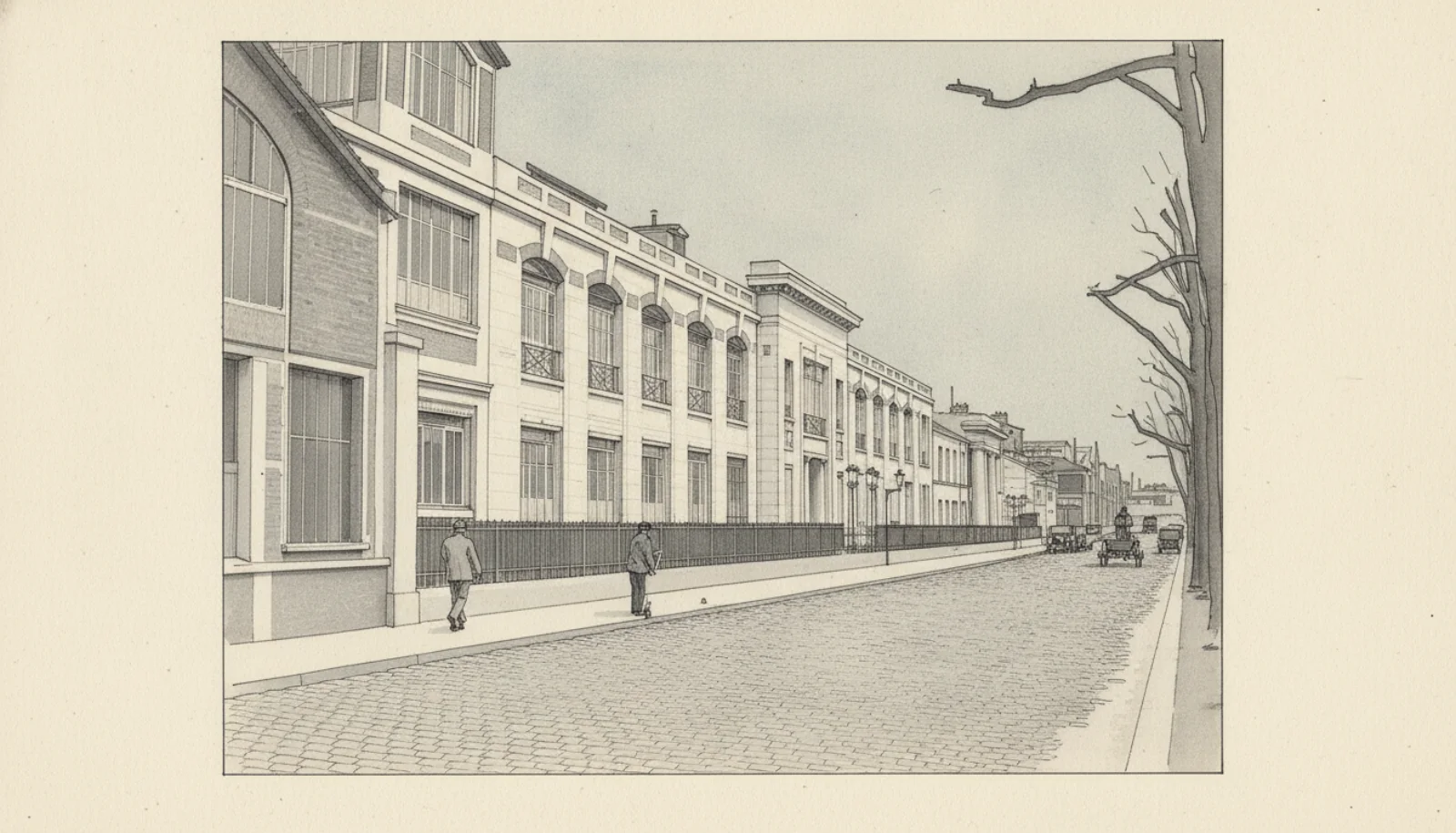
André Citroën set up a munitions works on the Seine at the quai de Javel in 1915, on land previously used by the Aciéries de France, to mass-produce 75 mm shrapnel shells for the French army. Run largely by women workers, it delivered some 23 million shells by 1918. Even before the armistice Citroën was planning to turn the plant over to cars, and in 1919 the Type A, designed with Jules Salomon, became the first European car built in large series on a production line here.
Through the 1920s Javel built the B2 and finished the small 5 HP, whose chassis came from Citroën's Levallois plant, and production rose to hundreds of cars a day. In 1933 André Citroën had the main factory demolished and rebuilt, much larger, in a matter of months to produce the front-wheel-drive Traction Avant, which went into volume production in April 1934; the cost helped push the company into the hands of its creditor Michelin. Under German occupation the plant built trucks for the occupiers and was bombed three times; a large fire damaged it in February 1949.
After the war Javel built the Traction until 1957, the Type H van from 1948, some 2CV production alongside Levallois, and from 1955 the DS and its ID sister, which became the plant's defining product: about 1.33 million of the DS family were made here. The SM was assembled here from 1970. Cramped on its city site, the works was wound down as Citroën moved to Aulnay-sous-Bois; the last DS left in April 1975. The buildings were demolished between 1976 and 1984 and part of the site became the Parc André-Citroën, opened in 1992.
Opened
Closed
- Status
- demolished
- Models built
- 10
- Components
- 1
- Peak workforce
- Not documented
- Location
- 48.8411, 2.2747
- Also called
- Javel, Quai de Javel works, Quai André-Citroën works, Usines André Citroën
Cars built here
- 1919–1921Citroën Type A (10 HP) · 24,093Calendar years, June 1919 to July 1921 (fr Wikipedia); Citroënvie gives 28 May 1919 for the start of production. Units are the whole-model total, all built here.
- 1921–1926Citroën B2 (10 HP)Calendar years, May 1921 to July 1926 (fr Wikipedia, which names Javel as the plant and gives 200 cars a day in 1925).
- 1922–1926Citroën Type C (5 HP)Final assembly only: chassis were assembled at Citroën's Levallois plant and the cars completed at Javel (fr and en Wikipedia). Calendar years of the model.
- 1932–1938Citroën Rosalie (8, 10, 15 CV)Calendar years of the model; fr Wikipedia names the quai de Javel works as the plant.
- 1934–1957Citroën Traction AvantVolume production began 19 April 1934 in the rebuilt factory; wartime interruption, resumed in the second half of 1945. Also assembled at Forest, Slough, Cologne and Copenhagen.
- 1948–1975Citroën Type H vanProduction at Javel began in June 1948 (fr Wikipedia, citing Sabatès and Jansen). The date it moved to Aulnay-sous-Bois, where it ended in December 1981, is not documented in sources opened; 1975 is the closure of Javel, used here only as the latest possible year.
- 1949–1969Citroën 2CVJavel 1949–1969 per the fr Wikipedia infobox; the 2CV's main French plant was Levallois (1949–1988), where series production began on 11 July 1949.
- 1955–1975Citroën DS · 1,330,755Calendar years; last DS off the line 24 April 1975. Units are the en Wikipedia figure for D-series cars made at Javel out of 1,455,746 built in six countries (the figure appears to include ID-family cars). en Wikipedia's SM article says runout DS models were built at Aulnay; other sources put the last DS at Javel.
- 1957–1969Citroën IDCalendar years for the ID 19 submodel (en Wikipedia); fr Wikipedia names Paris Javel as the ID's plant. Later D-series derivatives sold under DS names are covered by the DS entry.
- 1970–1974Citroën SMBodies came from Chausson at Gennevilliers; assembly at Javel until the plant's run-down, after which the final 135 cars were built by Ligier near Vichy (Abrest). Total SM production 12,920 (1970–1975).
Parts made here
- 75 mm shrapnel artillery shells · 1915–1918About 23 million delivered 1915–1918 (fr Wikipedia). Daily output figures differ by source: 5,000 a day in 1915 rising to 40,000 in 1918 (fr Wikipedia), over 35,000 a day at the peak (Citroënvie), 50,000 a day (fr/en Type C article).
Pictures
Milestones
- 1915
André Citroën builds a shell factory on the former Aciéries de France land at the quai de Javel.
- 1918
Shell output reaches its wartime peak; about 23 million shells delivered since 1915.
- 1919
Type A goes into production, the first European car built in large series on a line.
- 1921
B2 replaces the Type A (May).
- 1925
B2 output reaches 200 cars a day.
- 1933
Old factory demolished from 15 March and a new, four-times-larger building put up from 21 April for the Traction Avant.
- 1934
Traction Avant volume production starts 19 April; Citroën fails at the end of the year and Michelin takes control.
- 1940
German forces take over the plant in June and continue Type 23 truck production.
- 1948
Type H van production begins at Javel in June.
- 1949
Major fire damages the site on 2 February.
- 1955
DS 19 unveiled at the Paris Salon on 7 October.
- 1958
Quai de Javel renamed quai André-Citroën (by arrêté of 13 June 1958).
- 1970
SM assembly begins.
- 1975
Last DS leaves the line on 24 April; car production at Javel ends.
- 1976
Demolition of the works begins (completed 1984).
- 1992
Parc André-Citroën opens on part of the former site.
Sources
- Usines Citroën du Quai de Javel — Wikipédia (fr)
- Quai André-Citroën — Wikipédia (fr)
- Parc André-Citroën — Wikipédia (fr)
- Citroën Type A, B2, Type C 5 HP, Rosalie, Traction Avant, Type H, 2 CV, DS, ID, SM, 23 (model articles and infoboxes) — Wikipédia (fr)
- Citroën DS — Wikipedia
- Citroën Traction Avant — Wikipedia
- Citroën SM — Wikipedia
- Citroën Type C 5HP — Wikipedia
- History of the Quai de Javel Citroën Factory in Paris — Citroënvie
- Citroën : les lieux et chiffres de production — Auto Forever
- Coordinates are the fr Wikipedia coordinates of the Parc André-Citroën (48.841112, 2.274722), which occupies part of the former works; the fr article on the works has no coordinates. The quai André-Citroën itself is at 48.844167, 2.275278. The exact footprint of the factory was not mapped from a source.
- Not confirmed at Javel: the B10 (1924–1925), B12 (1925–1927), B14 and C4/C6 (1928–1932) were almost certainly built at Javel but no source opened names the plant for them (the fr infoboxes leave 'usine' blank; the C4 article only says it was built on the B14's line). They are left out of `built` pending a Citroën heritage or Conservatoire source.
- 2CV: fr Wikipedia's infobox gives Javel 1949–1969 alongside Levallois (1949–1988); the fr article on the works says the 2CV was produced there from 1948. 2CV vans were built at Panhard's Ivry plant from 1955.
- Type 23 (T23) light truck: fr Wikipedia says the Germans continued Type 23 production at Javel from June 1940; where the T23 was built in other years (1935–1969) is not stated in sources opened, so it is not listed in `built`.
- Closure date conflicts: car production ended with the last DS on 24 April 1975 (en Wikipedia); en Wikipedia's SM article says the factory closed in 1974; Auto Forever gives 1919–1977 and says the site was sold to the City of Paris in 1974; fr Wikipedia says the works finally closed in 1982 when the head office left. 1975 is used.
- Founding conflict: fr Wikipedia says André Citroën acquired the land in 1915; Citroënvie says the Ministry of Armaments funded the purchase in 1914.
- Quai renaming: fr Wikipedia gives an arrêté of 13 June 1958; Citroënvie gives 9 October 1958.
- Total output: Auto Forever gives 3,227,105 cars built at Javel 1919–1977; fr Wikipedia says more than 3.22 million. Neither cites a primary source.
- Workforce: fr Wikipedia says the works covered 130,000 m² and employed nearly 30,000 people, 6,000 of them women, in 1928 (unreferenced, and close to figures usually given for all of Citroën); Citroënvie says more than 12,000 worked there in the First World War. workforcePeak is left null.
- No Citroën-published (Citroën Origins / Conservatoire) page could be read: citroenorigins.fr renders client-side and returned no content to the fetcher.