CitroënDS and ID (D series)
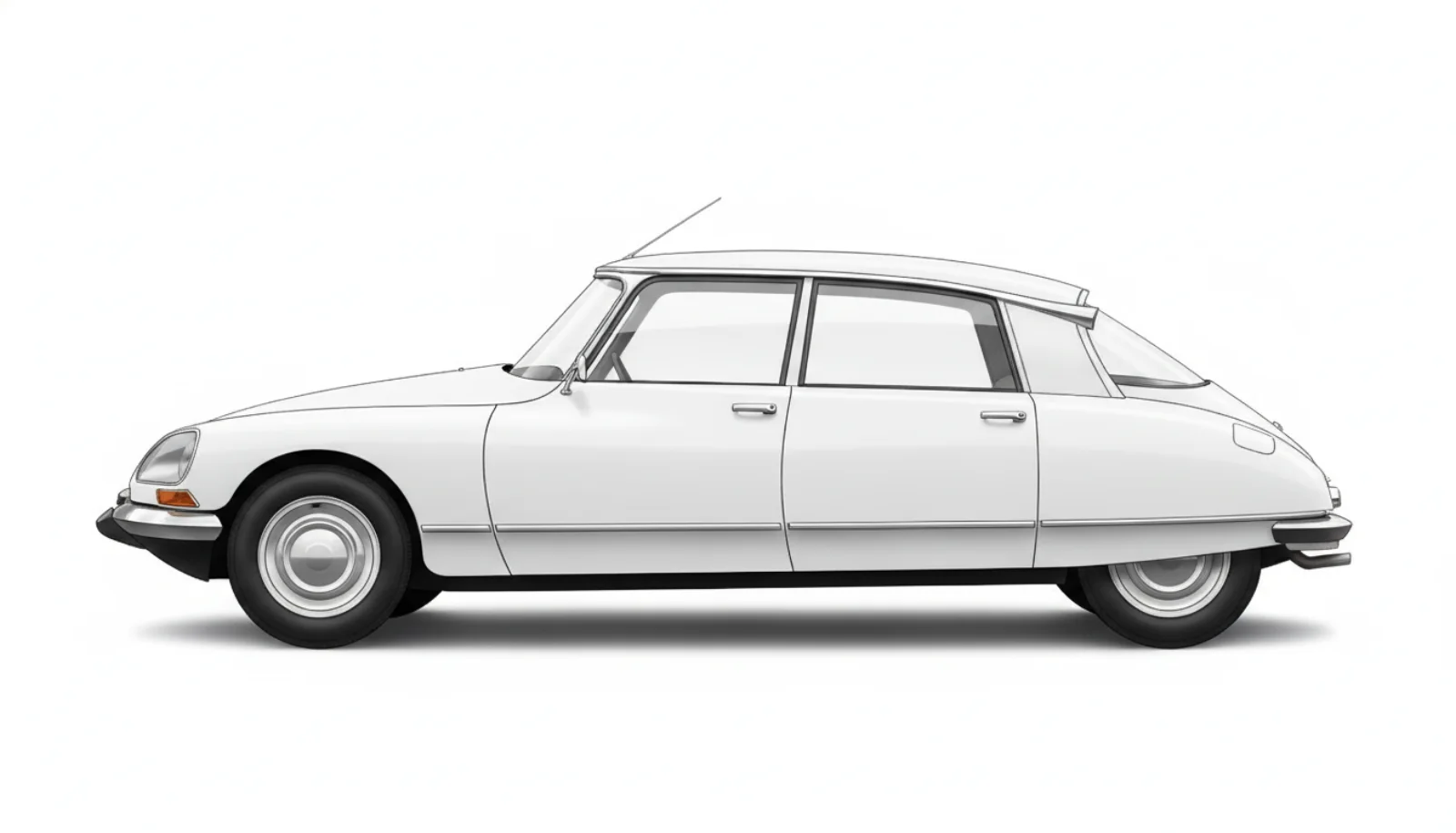
Noir · AC 200 · 1956–1975not offered in 1955
Screen approximation of the factory paint
Model year
Generation
First nose (1955-1962)
Built in 1955
Built in all, 1955–1975
Serial numbers, 1955
DS 19, model year 1956063 → 5889
Price new, 1955
Not documented
Origin
France
Front-engine, front-wheel drive
Citroën's large front-drive saloon, estate and convertible of 1955 to 1975, built on hydropneumatic self-levelling suspension with hydraulic steering, brakes and gearchange.
Executive car44 sources
How it launched in 1955
- 01DS 19 unveiled at the Paris Motor Show on 6 October 1955; English Wikipedia reports 743 orders in the first 15 minutes and 12,000 on the first day (German Wikipedia calls the 12,000 doubtful).
- 02Launch specification: 1,911 cc ohv four with alloy crossflow head, 75 bhp; hydropneumatic self-levelling suspension; hydraulic power steering, powered brakes with inboard front discs; hydraulically shifted four-speed gearbox with no clutch pedal; glass-fibre roof.
- 03HD19 records 62 cars of French production against model year 1955.
First nose (1955-1962), 1955–1962
The original front with open single headlamps and a short apron. DS 19 at 75 bhp, then 83 bhp from 1961; ID 19 from 1957 (Normale, Luxe, Confort); estates from 1958-59; the Chapron-built Décapotable from September 1960; 12-volt electrics from August 1960.
Body styles by year
Trim lines and engines, 1955
| Line | Power | Torque | 0–60 mph | Top speed | Weight |
|---|---|---|---|---|---|
1.9 L (78 x 100 mm) ohv inline-four, alloy crossflow head, Weber 24/30 DCLC twin-choke carburettor, 7.5:1 compression | 75 hp | — | 23.3 s | 86.5 mph | 2,716 lb |
DS 19 (75 bhp)
1955–1961
- Engine
- 1.9 L (78 x 100 mm) ohv inline-four, alloy crossflow head, Weber 24/30 DCLC twin-choke carburettor, 7.5:1 compression
- Displacement
- 1,911 cc
- Layout
- I4 · naturally aspirated · FWD
- Power
- 75 hp (b.h.p. at 4,500 rpm as listed by The Motor (1956); German Wikipedia gives 75 SAE-PS / about 70.5 DIN-PS)
- Torque
- Not documented
- 0–60 mph
- 23.3 s — The Motor, 5 December 1956 (Road Test No. 30/56, Slough-built car 293 ABH)
- Top speed
- 86.5 mph
- Weight
- 2,716 lb
- Gearboxes
- 4-speed hydraulically shifted semi-automatic, no clutch pedal
- Length × width × height
- Not documented
- Wheelbase
- 123 in
- Body styles
- Saloon (Berline)
- Price new
- F 1,109,000 (1956, France)
- Built
- Not documented
What this line added
- Hydropneumatic self-levelling suspension with driver-adjustable ride height
- Hydraulic power steering
- Hydraulically powered brakes, inboard front discs
- Hydraulic semi-automatic gearchange and clutch
- Glass-fibre roof panel
Factory colors, 1955
0 of 104 documented colors were offered this year. Pick one to repaint the page.
Interiors, 1955
Units built by year
Saloon (Berline), 1955
Left- and right-hand drive
The split is not documented.
No left/right-hand-drive split is documented. Right-hand-drive cars came from Slough (1956-1966), South Africa (1959-1975) and, after 1966, Paris for the UK and other RHD markets.
Total for all D-series cars including assembly outside France (English Wikipedia, Conceptcarz); 1,330,755 of them built in France (matches HD19's French production table). German Wikipedia gives 1,456,115. The calendar-year list English Wikipedia cites to John Reynolds adds up to 1,453,746.
Serial number ranges
| Series | Drive | Years | From | To |
|---|---|---|---|---|
| DS 19, model year 1956Late December 1955 to early October 1956. | — | 1955–1956 | 063 | 5889 |
| DS 19, model year 1957 | — | 1956–1957 | 5890 | 25476 |
| DS 19, model year 1958 | — | 1957–1958 | 25477 | 47499 |
| DS 19, model year 1959 | — | 1958–1959 | 47500 | 62587 |
| DS 19, model year 1960 (new series from October 1959)HD19: 62 588 to 64 000 to early October 1959, then 4 000 001-4 011 050 (to July 1960) and 4 013 001-4 014 058 (July-August 1960). | — | 1959–1960 | 4000001 | 4014058 |
| DS 19, model year 1961Two blocks: 4 014 059-4 025 194, then 4 205 001-4 215 702 (new series for the 83 bhp engine). | — | 1960–1961 | 4014059 | 4215702 |
| DS 19, model year 1962 | — | 1961–1962 | 4215703 | 4242537 |
| ID 19, model year 1957March to October 1957. | — | 1957 | 200001 | 203082 |
| ID 19 Luxe and Confort, model year 1958 | — | 1957–1958 | 203083 | 228890 |
| ID 19 Normale, model years 1958-59730 001-730 223 (1958) and 730 224-730 299 (1959). | — | 1958–1959 | 730001 | 730299 |
| ID 19 Luxe and Confort, model year 1959228 891-230 000, then the merged series 3 002 731-3 061 500 (merged at 3 008 761 on 1 January 1959). | — | 1958–1959 | 228891 | 3061500 |
| ID 19, model year 1960 | — | 1959–1960 | 3061500 | 3111999 |
| ID 19, model year 1961 | — | 1960–1961 | 3112000 | 3157754 |
| ID 19, model year 1962 | — | 1961–1962 | 3200001 | 3241403 |
| Cabriolet DS 19, model year 1962 | — | 1961–1962 | 4200290 | 4200466 |
| Cabriolet ID 19, model year 1962 | — | 1961–1962 | 3280602 | 3280652 |
| DS 19 semi-automatic, model year 1963Several blocks: 4 244 001-4 244 800, 4 244 901-4 247 000, 4 247 001-4 251 000, 4 251 201-4 271 373. | — | 1962–1963 | 4244001 | 4271373 |
| DS 19 M manual, model year 1963 | — | 1963 | 4400001 | 4406714 |
| DS 19 semi-automatic, model year 1964 | — | 1963–1964 | 4272302 | 4291669 |
| DS 19 M manual, model year 1964 | — | 1963–1964 | 4407201 | 4423244 |
| DS 19 semi-automatic, model year 19654 292 030-4 293 999, then from September 4 294 200-4 309 913. | — | 1964–1965 | 4292030 | 4309913 |
| DS 19 M manual, model year 19654 424 030-4 425 691, then from September 4 426 100-4 436 817. | — | 1964–1965 | 4424030 | 4436817 |
| DS 19 MA manual (1,985 cc), model year 1966 | — | 1965–1966 | 4438001 | 4441751 |
| DS 21 semi-automatic, model year 1966 | — | 1965–1966 | 4350200 | 4374711 |
| DS 21 M manual, model year 1966 | — | 1965–1966 | 4460100 | 4471616 |
| DS 19 A semi-automatic, model year 1967 | — | 1966–1967 | 4316000 | 4321976 |
| DS 19 MA manual, model year 1967 | — | 1966–1967 | 4442000 | 4445527 |
| DS 21 semi-automatic, model year 1967 | — | 1966–1967 | 4376200 | 4395446 |
| DS 21 M manual, model year 1967 | — | 1966–1967 | 4473100 | 4480621 |
| ID 19, model year 1963Blocks 3 242 001-3 256 000, 3 257 001-3 279 999, 3 282 001-3 285 956. | — | 1962–1963 | 3242001 | 3285956 |
| ID 19, model year 19643 287 001-3 299 999, then 3 605 001-3 629 166. | — | 1963–1964 | 3287001 | 3629166 |
| ID 19, model year 1966 | — | 1965–1966 | 3675001 | 3709947 |
| ID 19, model year 1967As printed by HD19; the start overlaps the 1966 range. | — | 1966–1967 | 3701001 | 3752472 |
| Cabriolet DS 21 (Citroën), model year 1966Semi-automatic; DS 21 M cabriolets 4 460 020-4 460 075; Chapron-numbered cars 4 350 001-4 350 026 and 4 460 001-4 460 006. | — | 1965–1966 | 4350030 | 4350143 |
| Cabriolet DS 21 (Citroën), model year 1967Semi-automatic; DS 21 M cabriolets 4 473 020-4 473 062. | — | 1966–1967 | 4376050 | 4376127 |
| DS 19 A semi-automatic, model year 1968 | — | 1967–1968 | 4323001 | 4329873 |
| DS 19 MA manual, model year 1968 | — | 1967–1968 | 4446001 | 4449506 |
| DS 21 semi-automatic and cabriolets, model year 1968 | — | 1967–1968 | 4600000 | 4620761 |
| DS 21 M manual and cabriolets, model year 1968 | — | 1967–1968 | 4482000 | 4489890 |
| DS 20 semi-automatic, model year 1969 | — | 1968–1969 | 4332001 | 4340716 |
| DS 20 M manual, model year 1969 | — | 1968–1969 | 4451001 | 4454602 |
| DS 21 semi-automatic and cabriolets, model year 19694 621 000-4 622 708, then 4 627 002-4 639 630. | — | 1968–1969 | 4621000 | 4639630 |
| DS 20 semi-automatic, model year 1970 | — | 1969–1970 | 4341301 | 4348018 |
| DS 21 semi-automatic and cabriolets, model year 1970 | — | 1969–1970 | 4640501 | 4647849 |
| DS 21 M manual and cabriolets, model year 1970 | — | 1969–1970 | 4497501 | 4501356 |
| DS 21 IE semi-automatic, model year 1970 | — | 1969–1970 | 00 FA 0003 | 01 FA 3636 |
| DS 20 semi-automatic, model year 1971 | — | 1970–1971 | 4700001 | 4705833 |
| DS 21 semi-automatic and cabriolets, model year 1971 | — | 1970–1971 | 4648501 | 4653749 |
| DS 21 M five-speed and cabriolets, model year 1971 | — | 1970–1971 | 4505001 | 4509438 |
| DS 20 semi-automatic, model year 1972 | — | 1971–1972 | 4707501 | 4714135 |
| DS 21 semi-automatic, model year 1972 | — | 1971–1972 | 4658011 | 4663585 |
| DS 20 semi-automatic, model year 1973 | — | 1972–1973 | 4714501 | 4721059 |
| D Super 5, model year 1973 | — | 1972–1973 | 4516001 | 4543464 |
| DS 23 / DS 23 M (carburettor), model year 1973 | — | 1972–1973 | 00 FE 0001 | 00 FE 9638 |
| DS 23 IE / DS 23 IE M, model year 1973 | — | 1972–1973 | 00 FG 0001 | 00 FG 4921 |
| DS 20 semi-automatic, model year 1974 | — | 1973–1974 | 4721501 | 4727710 |
| D Super 5, model year 1974 | — | 1973–1974 | 4553501 | 4560973 |
| DS 23 semi-automatic, model year 1974 | — | 1973–1974 | 01 FE 0001 | 01 FE 6446 |
| DS 23 IE semi-automatic, model year 1974 | — | 1973–1974 | 01 FG 5001 | 02 FG 4095 |
| DS 20 semi-automatic, model year 1975HD19 gives no final number. | — | 1974–1975 | 4728201 | … |
| D Super 5, model year 1975HD19 gives no final number. | — | 1974–1975 | 4565001 | … |
| ID 19 B, model year 1968 | — | 1967–1968 | 3757001 | 3794454 |
| ID 19 MA, model year 1968 | — | 1967–1968 | 3521200 | 3523522 |
| ID 20, model year 1969 | — | 1968–1969 | 3820001 | 3836155 |
| D Spécial (ID 19), model year 1970 | — | 1969–1970 | 3900000 | 3929133 |
| D Super (ID 20), model year 1970 | — | 1969–1970 | 3837000 | 3865268 |
| D Spécial (ID 19), model year 1971 | — | 1970–1971 | 3931001 | 3955833 |
| D Spécial, model year 1972 | — | 1971–1972 | 00 FC 0002 | 02 FC 3482 |
| D Super, model year 1972 | — | 1971–1972 | 00 FD 0003 | 03 FD 2274 |
| D Spécial / D Super, model year 1973 | — | 1972–1973 | 04 FD 0001 | 07 FD 0578 |
| D Spécial / D Super, model year 1974 | — | 1973–1974 | 07 FD 1001 | 09 FD 8907 |
| D Spécial / D Super, model year 1975HD19 gives no final number. | — | 1974–1975 | 10 FD 5001 | … |
| Break DS 20 (ID 20 FF), model year 1973 | — | 1972–1973 | 8404001 | 8407841 |
| Break DS 23 FF, model year 1973 | — | 1972–1973 | 00 FF 0001 | 00 FF 2847 |
| Break DS 20, model year 1974 | — | 1973–1974 | 8408001 | 8411610 |
| Break DS 23, model year 1974 | — | 1973–1974 | 00 FF 3001 | 00 FF 5371 |
The car
The DS 19 was unveiled at the Paris Motor Show on 6 October 1955 to replace the Traction Avant. It kept a pre-war 1,911 cc four-cylinder engine but surrounded it with a high-pressure hydraulic system that powered self-levelling hydropneumatic suspension, the steering, the brakes (with inboard front discs) and a clutchless gearchange. Flaminio Bertoni's body had a glass-fibre roof and unstressed bolt-on panels. A simplified ID 19, with a conventional gearbox and unassisted controls, followed in 1957 and became the volume model.
The range grew to an estate (Break, Familiale and Commerciale in France; Safari in Britain) from 1958-59, a Chapron-built Décapotable sold through Citroën dealers from 1960 to 1971, and the Pallas luxury trim from 1964. Two nose restyles divide the cars into three generations: a smoother front in September 1962 and Robert Opron's four-lamp nose with steering-linked inner headlamps in autumn 1967. Five-bearing 2.0 and 2.2-litre engines arrived in 1965 (DS 19 A, DS 21), electronic fuel injection in 1969 and the 2.3-litre DS 23 in 1972, while the ID line became the D Spécial and D Super.
The hydraulic fluid changed in September 1966 from synthetic LHS to green mineral LHM; the two are incompatible, which still matters to owners. French production by model year, as tabulated by HD19, was 493,724 DS saloons, 741,747 ID and D saloons, 93,919 estates and 1,365 cabriolets, totalling 1,330,755. The commonly quoted grand total including assembly abroad is 1,455,746. Cars were also assembled at Forest in Belgium, at Slough in England (right-hand drive, 1956-1966), in South Africa (1959-1975), in Australia (1961-1966), and in smaller numbers in Portugal and Yugoslavia. The last saloon left the line on 24 April 1975, and the CX replaced the range.
- Class
- Executive car
- Layout
- Front-engine, front-wheel drive
- Origin
- France
- Designers
- Flaminio Bertoni (styling), André Lefèbvre (engineering), Paul Magès (hydropneumatic suspension), Robert Opron (1967 front end), Henri Chapron (Décapotable coachwork)
- Also known as
- DS 19, ID 19, DS 20, DS 21, DS 23, D Spécial, D Super, Safari, Break, Familiale, Décapotable, DW, Déesse
- In production
- 1955–1975
Milestones
- 1955
DS 19 unveiled at the Paris Motor Show, 6 October.
- 1956
ID 19 announced at the Paris Salon; Slough begins right-hand-drive assembly.
- 1957
ID 19 production begins in March.
- 1958
Estate (Break) shown at the Paris Salon.
- 1959
Monte Carlo Rally win; South African assembly begins late in the year.
- 1960
Décapotable shown at the Paris Salon; on sale from September.
- 1962
Second nose (September); de Gaulle survives the Petit-Clamart attack in a DS (22 August).
- 1964
Pallas trim launched at the Paris Salon.
- 1965
DS 21 and five-bearing engines (September).
- 1966
Slough plant closes (18 February); LHM fluid introduced (September).
- 1967
Third nose with swivelling headlamps (autumn).
- 1969
Millionth D-series car; DS 21 Injection Électronique (October).
- 1971
Décapotable dropped (summer).
- 1972
DS 23 replaces the DS 21.
- 1975
Last DS saloon built, 24 April.
Pictures
Illustrations are generated from period references and shown in the selected factory color; they are not photographs.
Where it was built
France · 1955–1975
Quai de Javel (Quai André-Citroën)
Paris
The factory, what else it built →
France · 1973–1975
Aulnay-sous-Bois
Aulnay-sous-Bois
Belgium · 1956–1969
Citroën Forest
Forest, Brussels
United Kingdom · 1956–1966
Citroën Cars Ltd, Trading Estate
Slough
South Africa · 1959–1975
Stanley Motors, Natalspruit (later Pretoria, then Port Elizabeth)
Natalspruit, Transvaal
Australia · 1961–1966
West Heidelberg assembly plant
Heidelberg, Victoria
Portugal
Mangualde
Mangualde
Slovenia
Tomos (Yugoslavia)
Koper
Where the cars went
- United States: English Wikipedia's total for North American sales (French Wikipedia: 38,000 sold in the United States); the figure carries no citation.
- South Africa, 1959: DS models sold in South Africa in 1959 (Citroënët).
Against its rivals
Same class, same years. Each rival is shown in the specification and year a buyer would have cross-shopped.
Longer is better. Figures are for the variant and year named under each car, from the sources listed below.
In the comparison
NSU Ro80 · 1973 · Germany
Car magazine's 1973 Giant Test pitched it against the DS23 as the other technically radical European executive saloon.
BMW 520 · 1973 · Germany
The conventional German executive saloon in the same Car magazine group test.
Rover 3500S · 1973 · United Kingdom
British executive saloon in Motor's 1973 comparison table for the DS23 Pallas EFI.
Mercedes-Benz 220 · 1973 · Germany
Four-cylinder German saloon in Motor's 1973 comparison table.
Peugeot 504 Estate · 1972 · France
French rival to the Safari estate in Car magazine's 1972 Giant Test.
Factory options
| Option | Code | Years | Price | Built with it |
|---|---|---|---|---|
| Pallas finishLuxury trim pack for the DS; see the Pallas variant. | — | 1964–1975 | £265.83 | — |
| Electronic fuel injection (DS 21 IE / DS 23 IE) | — | 1969–1975 | £263.41 | — |
| Metallic paint | — | — | £28.53 | — |
| Five-speed manual gearboxFrom September 1970 on the DS 21 M; optional on the D Super; standard on the D Super 5. | — | 1970–1975 | — | — |
| Borg-Warner three-speed automaticOptional on the DS 21 from September 1971, then the DS 23. | — | 1971–1975 | — | — |
| Swivelling inner headlampsStandard on Pallas and cabriolet from September 1967, extra-cost on ID and ordinary DS (all German and Austrian DS from September 1968). | — | 1967–1975 | — | — |
| Power steering on the IDOptional on the ID from October 1960 (German Wikipedia). | — | 1960–1975 | — | — |
| Manual gearbox on the DS (DS 19 M / DW)From February 1963. | — | 1963–1975 | — | — |
| Black roof (UK)No-cost option on ID, DW and DS (Ermine White roof on the Safari), Slough list of October 1963. | — | 1963–1964 | — | — |
| Duo-tone paint (UK)Extra cost on ID, DW, DS and Safari, Slough list of October 1963. | — | 1963–1964 | — | — |
| Quartz-halogen auxiliary driving lampsIntroduced 1964 (Citroënët); standard on the Pallas. | — | 1964–1967 | — | — |
| Anti-corrosion export treatmentFactory option box for export cars; 'finition spéciale Canada' from late 1965 (Nuancier). | ANTI CORROS | 1965–1969 | — | — |
| Car radioListed as optional in The Motor's 1956 test. | — | 1956–1975 | — | — |
Known issues
LHS and LHM hydraulic fluids are incompatible
1955–1975safetyCars built before September 1966 (model year 1967) use synthetic LHS fluid (red, then colourless LHS2 from 1964); later cars use green mineral LHM. The seals for one fluid are destroyed by the other, so the wrong fluid quickly ruins the whole system, including the brakes. US and Canadian cars kept LHS until January 1969.
Fix Identify the system before topping up (LHM parts are painted green); converting an LHS car means replacing nearly all seals. HD19 warns against silicone DOT 5 fluid.
Early LHS fluid attacked seals and caused leaks
1955–1966majorThe original LHS was hygroscopic, attacked paint, encouraged internal corrosion and damaged seals; French Wikipedia describes an epidemic of failures soon after launch. Citroën revised the fluid several times before LHM.
Fix Sources differ on when the reformulated LHS2 arrived (French Wikipedia 1957; HD19 and German Wikipedia 1964). Owners of LHS cars keep the system flushed and resealed.
Layered body structure traps water; 1970s cars rust deeper
1955–1975majorThe Nuancier describes the body as a 'mille-feuille' of overlapping sheets where moisture collects. Electrophoretic primer only arrived on the Javel line for model year 1970, and the author reports that 1970s cars nonetheless rust more deeply, which he attributes to poorer steel (unproven).
Fix Inspect the overlapping body structure and sills from beneath; a reddish primer under the black underside identifies a model-year 1970 or later body.
High-pressure hydraulics and fuel injection need specialist attention
1955–1975moderateAutocar's 1975 used-car guide said the hydraulics need specialist work and the injected models need specialist setting-up; engine access is hampered by wiring and hydraulic pipes. Suspension and steering sighs are normal.
Fix Use a D-series specialist; Autocar preferred the manual gearbox to the semi-automatic for simplicity.
Body sides easily damaged
1955–1975minorThe tumble-home of the body sides is easily damaged by gateposts; later cars have a rubbing strip that limits minor damage (Autocar, 1975).
How it was advertised
The DS 19 was unveiled at the Paris Motor Show on 6 October 1955 after eighteen years of secret development, and the launch itself was the campaign: 743 orders were taken in the first fifteen minutes, 12,000 on the first day and some 80,000 deposits over the ten days of the show. In France, Citroën's sales brochures and posters from about the mid-1950s for roughly a decade were produced by Robert Delpire and Claude Puech through the agency Delpire Publicité, using photographers such as Helmut Newton and Sarah Moon alongside illustrators and typographers; the agency also made Citroën television commercials, and in 1965 Delpire curated an exhibition in Paris on Citroën's graphic art and publicity. Citroën also used motor-show theatre, standing a DS body upright like a rocket on a turntable at the 1963 Amsterdam show, and its rally wins (Monte Carlo 1959 and 1966, among others).
In the United States, where the DS was sold from 1956 to 1972 as a luxury car and found only about 38,000 buyers, advertising was placed by Citroën Cars Corporation of New York and Beverly Hills in enthusiast magazines. The 1956 launch ad listed the car's unprecedented features and promised a ride like floating on air; by 1961 the ads used a single idea, such as the hydropneumatic suspension raising and lowering the car, set in bold type around two photographs. Another American line, "It takes a special person to drive a special car", summed up how the car was pitched to a small, self-selecting audience.
Where it ran: 8 documented placements
More advertisements, viewable at their source (11)
These are still under copyright, so we describe them and link to where they can be seen rather than reproduce them.
- 1956DS 19 the new Citroën... is here!magazine · Sports Cars Illustrated · 1956-07 · Car and Driver (via AOL) ↗US launch ad dominated by a single flowing line drawing of the DS profile, with small photographs of the front wing, single-spoke steering wheel and rear window, and CITROËN spelled vertically down the right margin. The copy calls the car years ahead, a blend of sports car and limousine, invites readers to a showroom demonstration, and lists its standard features from disc brakes to the self-levelling oil-air suspension.
- 1956Citroën DS 19 (US brochure)brochure · Internet Archive (Car Brochures & Adverts collection) ↗US-market brochure whose cover shows two dark hands releasing a ghostly white DS into a lavender sky beneath the Citroën double chevron, with the name in a red-and-black block.
- 1958Fahren Sie heute ... den Wagen von morgen!magazine · Internet Archive (Car Brochures & Adverts collection) ↗German ad from Citroën's Cologne branch inviting readers to drive tomorrow's car today: a large photograph of a DS 19 from the front quarter beneath a grid of panels on its hydropneumatic suspension, automatic clutch, powered brakes and steering, and safety, with prices for the DS 19 and ID 19.
- 1959An adventure in itselfmagazine · Internet Archive (Car Brochures & Adverts collection) ↗A white DS parked on a rocky shore beside two skin-divers, the Citroën name in tall display type above; a long list of US dealers fills the foot of the page under a price from $2,545.
- 1960Citroën: compactness with supreme comfortmagazine · Holiday · 1960-11 · Internet Archive (Car Brochures & Adverts collection) ↗A white DS on a lawn with a woman and a boy doing a handstand on a man's hands; the copy, written as American compacts arrived, calls Citroën the forerunner of the compact car and lists air-oil suspension, disc brakes and front-wheel drive.
- 1961This car has its ups and downsmagazine · Car and Driver · 1961-02 · Car and Driver (via AOL) ↗Two identical side views of a DS, one raised and one lowered, with the headline stacked in heavy type between them. The copy explains that the driver can change the car's ground clearance with a lever, for snow, ruts or a flat tyre, and calls this both French and logical.
- 1962Fahren ohne Gefahrenmagazine · Internet Archive (Car Brochures & Adverts collection) ↗A DS 19 seen from behind stopping sharply at a traffic light in front of a moving lorry, the words "Scheibenbremsen" painted on the road; the copy sells the powered disc brakes and the safety of the whole design.
- 1963DS body displayed as an upright sculptureother · Amsterdam International Autoshow · Wikipedia ↗Motor-show display in which Citroën stood a DS body on its tail like a rocket and turned it on a rotating platform.
- 1964Funny facemagazine · Internet Archive (Car Brochures & Adverts collection) ↗A close-up of a smiling woman with a fringe above a photograph of a DS from the front; the copy argues that the car's odd looks are the practical result of aerodynamics and visibility, and cites its economy and roominess.
- 1964DS (DS 19 Pallas brochure)brochure · 1964-06 · Internet Archive (Car Brochures & Adverts collection) ↗Fold-out French brochure for the new Pallas luxury trim, its cover purely typographic: a giant lower-case "ds" in pale gold on orange with a small floral emblem.
- 1971Spacious rural retreat with miles of drive.magazine · Autocar · 1971-07-01 · Internet Archive (Car Brochures & Adverts collection) ↗Painted illustration of a white DS Safari estate at country-house gates, with an estate-agent-style panel of features parodying a property listing; placed by Citroën Cars Ltd of Slough.
No DS advertisement with a public-domain or open licence was found on Wikimedia Commons (the Citroën advertisements category there holds only 1919–1925 and 2CV material). French press advertising remains the main gap: Delpire's DS brochures and posters are documented only in general terms and only one French brochure (1964 Pallas) was opened; individual French magazine ads could not be traced because the web-search budget for this run was exhausted. The AHPS library has no Citroën ads. The American line "It takes a special person to drive a special car" is quoted by Wikipedia without a year or publication, so it is mentioned in the overview but not listed as an ad. The 1956 ad is listed by Car and Driver as July 1956, when the magazine was titled Sports Cars Illustrated (renamed Car and Driver in 1961). Internet Archive items come from a collectors' group upload with no licence statement and are link-only; dates and markets are as given in their titles. An item titled "1973 Citroën DS UK Ad" is a modern art print quoting old slogans and is excluded. The 1960 Holiday ad's year comes from the item title; the page folio shows only "Holiday/November".
Sources
- 1Numéros de série: présentation, with 'Chiffres de production française T.T.' by model year 1955-1975 (DS, ID, Break, Cabriolet) — HD19 (hd19.net, DS/ID technical site) club
- 2Numéros de série DS 19, 20, 21, 23 by model year — HD19 (hd19.net) club
- 3Numéros de série ID 19, 20 / D Spécial, D Super by model year — HD19 (hd19.net) club
- 4Numéros de série ID-DS Break, with French Break production by model year — HD19 (hd19.net) club
- 5Numéros de série ID/DS Cabriolets, with French cabriolet production by model year — HD19 (hd19.net) club
- 6La petite histoire illustrée du LHS-LHM et du Silicone — HD19 (hd19.net) club
- 7Le Nuancier DS: model-year colour charts 1956-1962 (pages 1956.htm to 1962.htm) — Le Nuancier DS (Dr Danche) club
- 8Le Nuancier DS: model-year colour charts 1963-1967 (pages 1963.htm to 1967.htm) — Le Nuancier DS (Dr Danche) club
- 9Le Nuancier DS: model-year colour charts 1968-1975 (pages 1968.htm to 1975.htm) — Le Nuancier DS (Dr Danche) club
- 10Danchorama: all DS/ID body colours with AC codes and years — Le Nuancier DS (Dr Danche) club
- 11Teintes des cabriolets (convertible colour chart 1961-1971) — Le Nuancier DS (Dr Danche) club
- 12The DS in England: Slough colours — Le Nuancier DS (Dr Danche) club
- 13Citroën D models in Australia (ID 19 Parisienne, West Heidelberg) — Le Nuancier DS (Dr Danche) club
- 14La DS en Belgique: Forest — Le Nuancier DS (Dr Danche) club
- 15La DS au Portugal (Mangualde) — Le Nuancier DS (Dr Danche) club
- 16La DS en Yougoslavie (Slovénie) — Le Nuancier DS (Dr Danche) club
- 17La DS en Afrique du Sud — Le Nuancier DS (Dr Danche) club
- 18L'électrophorèse sur les DS et ID — Le Nuancier DS (Dr Danche) club
- 19D series: Evolution — Citroënët (Julian Marsh) reference
- 20DS Technical History — Citroënët (Julian Marsh) reference
- 21ID Technical History — Citroënët (Julian Marsh) reference
- 22ID, D Spécial and D Super — Citroënët (Julian Marsh) reference
- 23ID Break estate cars — Citroënët (Julian Marsh) reference
- 24Citroën in Belgium: production figures 1948-1979 — Citroënët (Julian Marsh) reference
- 25Made in South Africa / Vervaardig in Suid-Afrika — Citroënët (Julian Marsh) reference
- 261971 Car (South Africa) test of the DS-20 — Citroënët / Car magazine (South Africa) period-test
- 27The English Goddess: Slough-built D series — Citroënët (Julian Marsh) reference
- 28Citroën Cars Ltd price list effective 1 February 1960 — Citroën Cars Ltd, Slough (reproduced by Citroënët) factory
- 29Citroën Cars Ltd price list and colour list effective 16 October 1963 — Citroën Cars Ltd, Slough (reproduced by Citroënët) factory
- 30The Yugoslav Citroëns: Tomos and Cimos — Citroënët (Julian Marsh) reference
- 31The Chapron 'Usine' (factory) cabriolets — Citroënët (Julian Marsh) reference
- 32The Motor Road Test No. 30/56 (Continental): Citroën DS19, 5 December 1956 — The Motor (reprint reproduced by Citroënët) period-test
- 33Road Test: The latest Citroën DW (March 1964) — Motor Sport period-test
- 34Motor road test: Citroën DS23 Pallas EFI (1973) — Motor (reproduced by Citroënët) period-test
- 35Giant Test: Citroën DS23 v NSU Ro80 v BMW 520 (July 1973) — Car magazine (reproduced by Citroënët) period-test
- 36Giant Test: Citroën Safari v Peugeot 504 Estate v Volvo 145 (1972) — Car magazine (reproduced by Citroënët) period-test
- 37Four-way selecting secondhand (1975), Citroën DS section — Autocar (reproduced by Citroënët) period-test
- 38Citroën DS (production-by-year list cited to John Reynolds, Original Citroën DS, Bay View Books 1996, p. 135) — Wikipedia (English) reference
- 39Citroën DS — Wikipédia (French) reference
- 40Citroën DS (Detailentwicklung chronology) — Wikipedia (German) reference
- 41Citroën DS Cabriolet Usine (production table citing Meyer-Spelbrink, Citroën DS, Podszun 2003, p. 71) — Wikipedia (German) reference
- 421969 Citroën DS21 specifications — Conceptcarz reference
- 43Paint codes: 1972 Citroën — Paintref.com reference
- 44Citroën ID19: photos, détails et équipements — Citroën Origins (Citroën heritage site) factory
Research notes: what is not documented, and where sources disagree (21)
- Production per model year (modelYears[].units and unitsByBody) is HD19's table of French production ('production française T.T.') by model year. It excludes cars assembled outside France. 'berline' units are HD19's DS plus ID columns; cabriolets are counted separately.
- HD19's table has internal errors. The ID column total is printed as 714,747 but its rows add up to 741,747, the figure that makes the printed grand total of 1,330,755 work (used in the summary). The 1964 row total (82,503) is copied from 1963, so 1964 units are left null; its components (31,630 DS + 39,294 ID, 5,975 Break) are given, with 184 cabriolets from HD19's own cabriolet table, where the presentation table repeats 245. Rows for 1962, 1966 and 1968 differ from their printed totals by 19, 27 and 1 cars; the printed totals are used.
- Calendar-year production cited by English Wikipedia to John Reynolds (Original Citroën DS, 1996, p. 135), apparently all D-series output: 1955 69; 1956 9,868; 1957 28,593; 1958 52,416; 1959 66,931; 1960 83,205; 1961 77,597; 1962 83,035; 1963 93,476; 1964 85,379; 1965 89,314; 1966 99,561; 1967 101,904; 1968 81,860; 1969 82,218; 1970 103,633; 1971 84,328; 1972 92,483; 1973 96,990; 1974 40,039; 1975 847. These add up to 1,453,746, 2,000 short of the 1,455,746 total. The 1974 and 1975 figures equal HD19's French model-year totals.
- French Wikipedia says the run included '493,724 breaks DS'. That is HD19's figure for DS saloons. HD19 gives 93,919 French-built estates (71,256 ID 19/20, 17,057 ID 21, 5,606 DS 23).
- Cabriolet totals conflict: HD19 gives 1,365 French Cabriolets Usine (112 ID 19, 770 DS 19, 483 DS 21). German Wikipedia, citing Meyer-Spelbrink, gives 1,325 (106 ID, 1,219 DS) by calendar year: ID 1960 1, 1961 32, 1962 28, 1963 34, 1964 5, 1965 6; DS 1961 130, 1962 181, 1963 207, 1964 179, 1965 121, 1966 124, 1967 82, 1968 95, 1969 47, 1970 40, 1971 13. It adds about seven later customer cars to 1974. English Wikipedia says about 1,400; the Nuancier says about 1,500.
- Assembly abroad, units by plant. Belgium (Forest): Citroënët's production table gives 97,765 D-series cars, 1956-1969 (418, 786, 2,901, 5,796, 7,451, 6,926, 7,622, 8,376, 7,887, 8,100, 15,786, 8,176, 7,372, 10,168); Citroënët does not cite the table's source. South Africa: 10,944 DS (Citroënët). Slough: the Nuancier suggests about 9,000 with a question mark; no reliable figure was found. Australia (Heidelberg, ID 19 'Parisienne', 1961-66), Portugal (Mangualde, 'a handful') and Yugoslavia (Tomos, Koper): no counts were found. A 1,000-car Yugoslav figure exists only as an unverified forum post. Citroënët's Yugoslav page lists the 2CV, H van, Ami, Dyane, Méhari, GS/GA and CX but not the DS.
- English Wikipedia attributes the 124,991 cars built outside France to Australia, Portugal, the UK, South Africa and Yugoslavia, and does not list Belgium. Citroënët's Belgian figure alone (97,765) is most of that difference, so the attribution is doubtful. No per-country split was apportioned here.
- Assembly years: Slough 1956-1966 (Nuancier; English Wikipedia says assembly ran until 1965 and the plant closed on 18 February 1966); Forest 1956-1969 (Nuancier and Citroënët's table); South Africa late 1959-1975 (Natalspruit, then Pretoria and Port Elizabeth from 1969-70); Australia 1961-1966. Years for Mangualde and Koper are not documented. Koper is entered with its present country (SI).
- Estate introduction: English Wikipedia says 1958 (Paris Salon); HD19 records the first French production (820) in model year 1959; Citroënët's Break page says 'launched in 1960'. Seating: Citroënët gives six-seat Break and eight-seat Familiale.
- LHS2: French Wikipedia dates the reformulated fluid to 1957; HD19 and German Wikipedia to 1964. The LHM date is September 1966 (HD19) or October 1966 (French Wikipedia), model year 1967 in both.
- Power figures differ by source and rating standard. Citroënët's technical tables give bhp without naming the standard. German Wikipedia gives DIN-PS, and The Motor 1956 and Motor 1973 give their own figures. The powerNote on each variant says which figure is used. ID 19 launch power: 66 bhp (Citroënët) or 69 hp (English Wikipedia, Bellu). DS 23 carburettor: 124 bhp (Citroënët), 110 DIN-PS (German Wikipedia) or 115 hp (English Wikipedia).
- Converted values: the DS 19 weight (2,716 lb) is The Motor's 24.25 cwt kerb weight, and the DS 23 IE weight (3,002 lb) is Motor's 26.8 cwt. The ID 19 Break weight (3,051 lb) is English Wikipedia's 1,384 kg estate kerb weight, which it does not tie to a particular year. ID 19 dimensions and weight (4.81 x 1.79 x 1.47 m, 1,120 kg) come from Citroën Origins, and its top speed (135 km/h, 84 mph) from Citroënët. The DS 21 IE top speed is Citroënët's 188 km/h. The DS 20 torque is 146 N.m. Rival weights are Motor's cwt figures. Pre-decimal UK prices are given in decimal pounds, with the original £ s d in each note.
- Prices not found: French list prices beyond 1956-57 (DS 1,109,000 F in 1956 per Sedgwick via English Wikipedia; DS 965,000 F and ID 19 Normale 860,000 F in October 1957 per Citroënët; ID 19 Luxe 925,000 F at the 1956 Salon), and US prices other than Conceptcarz's 1969 DS 21 range ($3,615-$4,170). A 1959 US ID 19 price of $2,833 appeared in a fetched summary of English Wikipedia but could not be found in the article source, so it is not used.
- Weights, 0-60 times and top speeds for most variants were not documented in a period test I could open. The 1956 Autocar and Autosport tests on Citroënët are image scans that were not read. Car magazine's 1972 Safari test labels its car a 'Safari 21' but says in a footnote that it was a 23; its 106 bhp, 110 mph and 13.4 s figures are therefore not attached to a specific estate variant.
- Colours: the Nuancier DS model-year charts (1956-1975) are the source for French AC codes and years. In several years the charts mark which colours applied to DS, ID or Break, but those marks could not be read reliably from the page text, so model restrictions are noted only where the chart states them in words. Finish: the Nuancier names only Sable Métallisé as metallic. Brun Scarabée is marked metallic from Paintref's 1972 refinish listing, and Silver Blue and Tudor Grey from the Slough list ('Metallichrome'). The rest are entered as solid because no source states otherwise. Some later colours, such as Gris Nacré, Bleu Platine, Vert Argenté, Bronze and Beige Tholonet, may in fact be metallic; this was not verified.
- Slough colours: the Nuancier calls its year ranges 'only a guide' because Citroën's documents contradict each other, and notes that Slough could supply any ICI or Valentine colour. Only the six colours on the 16 October 1963 factory list are confirmed by a factory document; Regal Red, Thundercloud Grey, Mist Grey and Cream are included with the Nuancier's (unqualified) years. Slough colours the Nuancier gives only with question-marked or single years were left out: Sherwood Green, Black, Airways Blue, Avion Blue, Off-White, Daffodil Yellow, Coral, Dove Grey, Pearl White, Solent Blue, Minster Grey, Pastel Blue, and Diamond Blue and Clover Green (both metallic). The 1963 Drophead Coupé was offered in 13 colours, 12 of them Metallichrome; these are not named.
- Units per colour: no registry documents production by colour, so all colour units are left out.
- Serial ranges are HD19's French serial numbers by model year, written without the thousands spaces HD19 uses; the type-coded numbers from 1970 onward (for example 00 FA 0003) are kept as printed. Ranges that look misprinted were left out: the 1966 DS 19 A semi-automatic range (identical to the 1964 range), ID 19 1965 ('3 630 00'), ID 19 B 1969 ('3 794 60'), D Super 1971 (ending '8 004 238'), the 1972 Break ID 20 F ('8 100 001 à 840 378') and the 1960 Break range (identical to the saloon range). HD19's 1972 DS 21 M IE range repeats the 1971 one and was also left out. Left- and right-hand-drive serial runs are not documented.
- Markets: the 38,000 North American (or US) sales figure is uncited in both Wikipedias. Citroënët gives 407 DS sold in South Africa in 1959 and 'about 7,300' D-series sales in 1969; it is unclear whether 7,300 is cumulative, so it is not entered. No delivery figures by country were found for France, the UK or other markets.
- Known issues: the main buyer's guides (Car & Classic, Honest John, Hagerty, Classic & Sports Car) could not be opened (blocked or not found). The rust entry rests only on the Nuancier's electrophoresis article, so specific rust locations (for example sills, floor or boot floor) are not documented here.
- The ID 19 Normale years follow HD19's serials (January 1958 to model year 1959) and Citroënët's October 1957 launch; Citroënët's ID table gives 1957-1960.
44 sources. Paint swatches are screen approximations of the factory colors.