Model year
Generation
F40
Built in 1987
Not documented
Built in all, 1987–1992
Serial numbers, 1987
Production cars, all specifications76624 → 95317
Prototypes and pre-series cars (documented examples)74045 → 74049
First series with sliding Lexan windows (about 50 cars)76624 → 77088
Price new, 1987
L. 380,000,000
Italy · Original list price as stated by Ferrari
Origin
Italy
Rear mid-engine, rear-wheel drive
Twin-turbocharged V8 berlinetta built to mark Ferrari's 40th anniversary; 1,311 left Maranello, all of them red.
SupercarLHD 1,311RHD 028 sources
How it launched in 1987
- 01Presented to the press at the Civic Centre, Maranello, on 21 July 1987; Ferrari records 900 orders at the unveiling against an initial plan of about 400 cars.
- 02Launch specification: 2,936 cc twin-turbocharged V8 rated at 478 hp at 7,000 rpm, five-speed gearbox, tubular steel frame with bonded composite panels, eleven composite body panels.
- 03Rosso Corsa paint only, red cloth seats, left-hand drive only; no carpets, door trims or radio.
- 04Only prototypes and pre-series cars were completed this year. Documented prototype chassis include 74045, 74047 and 74049.
F40, 1987–1992
One generation with running changes. Early cars have sliding Lexan side windows, no catalysts and fixed-height suspension. Wind-up windows followed after about 50 cars, catalytic converters from 1990 to 1991, and optional adjustable suspension from 1991. US-specification cars were built for the 1990, 1991 and 1992 model years. The LM and Competizione race cars were built by Michelotto on chassis numbered in the same sequence.
Built, this generation 1,311
Body styles by year
Trim lines and engines, 1987
| Line | Power | Torque | 0–60 mph | Top speed | Weight |
|---|---|---|---|---|---|
2.9 L Tipo F120 A 90° V8, four valves per cylinder, twin IHI turbochargers with Behr intercoolers, Weber-Marelli injection, dry sump | 478 hp | 426 lb-ft | 4.4 s | 201 mph | 2,765 lb |
F40 (European specification)
1987–1992
- Engine
- 2.9 L Tipo F120 A 90° V8, four valves per cylinder, twin IHI turbochargers with Behr intercoolers, Weber-Marelli injection, dry sump
- Displacement
- 2,936 cc
- Layout
- V8 · twin-turbo · RWD
- Power
- 478 hp (Ferrari factory figure: 351.5 kW (478 hp) at 7,000 rpm. Later catalysed European cars used the Tipo F120 D engine, for which Supercar Nostalgia quotes 484 bhp.)
- Torque
- 426 lb-ft
- 0–60 mph
- 4.4 s — auto motor und sport, as tabulated by AutoZine (the same magazine's issue 2/1989 lists 0–100 km/h in 4.6 s). Fast Lane recorded 3.9 s. Ferrari claims 0–100 km/h in 4.1 s.
- Top speed
- 201 mph
- Weight
- 2,765 lb
- Gearboxes
- 5-speed manual; 5-speed manual, non-synchromesh sports gearbox (option)
- Length × width × height
- 171.6 × 77.6 × 44.3 in
- Wheelbase
- 96.5 in
- Body styles
- Berlinetta
- Price new
- L. 380,000,000 (1987, Italy)
- Built
- Not documented
What this line added
- Rosso Corsa paint, red cloth-trimmed Kevlar shell seats
- Air conditioning
- Two rubber bag fuel tanks, 120 litres in total
- Speedline 17-inch centre-lock wheels with Pirelli P Zero tyres (245/40 ZR17 front, 335/35 ZR17 rear)
- Sliding Lexan side windows on about the first 50 cars, wind-up glass afterwards
- Catalytic converters on later cars (from 1990 to 1991)
- Adjustable ride-height suspension optional from 1991
Factory colors, 1987
1 of 1 documented colors were offered this year. Pick one to repaint the page.
Interiors, 1987
Units built by year
Year-by-year production is not documented for this car.
Left- and right-hand drive
Built in left-hand drive only. About seven cars were converted to right-hand drive by Pininfarina for the Sultan of Brunei after leaving the factory.
Ferrari's own figure for cars that left the Maranello factory by the end of production in 1992. RM Sotheby's, Motor Sport, PistonHeads and others quote 1,315.
Serial number ranges
| Series | Drive | Years | From | To |
|---|---|---|---|---|
| Production cars, all specificationsChassis numbers were drawn from Ferrari's continuous road-car sequence shared with other models, so the 1,311 cars are scattered through this range rather than consecutive. | LHD | 1987–1992 | 76624 | 95317 |
| Prototypes and pre-series cars (documented examples)Documented prototype chassis are 74045, 74047 and 74049; this is not a continuous block. DK Engineering cites research suggesting about nine prototypes were built. | LHD | 1987 | 74045 | 74049 |
| First series with sliding Lexan windows (about 50 cars)End point as given by Italian Wikipedia; start point is the first production chassis listed by the Dacorsa registry. | LHD | 1987–1988 | 76624 | 77088 |
| US specification, 1990 model yearEnthusiast compilation from build records (TeamSpeed, 2008), not a factory list. US cars are interleaved with European cars in the sequence. | LHD | 1990 | 84729 | 87324 |
| US specification, 1991 model yearEnthusiast compilation from build records (TeamSpeed, 2008), not a factory list. | LHD | 1990–1991 | 87345 | 90279 |
| US specification, 1992 model yearEnthusiast compilation from build records (TeamSpeed, 2008), not a factory list. | LHD | 1991–1992 | 90354 | 93627 |
| F40 LM, Michelotto build numbers 1 to 20 (17 not used)Nineteen chassis, not consecutive: 74045 (converted pre-production car), 79890, 79891, 88513, 88520, 88521, 88522, 88523, 88524, 92235, 92236, 92237, 92238, 95448, 95449, 97881, 97893, 97904, 99401. | — | 1988–1994 | 79890 | 99401 |
The car
The F40 was shown to the press at the Civic Centre in Maranello on 21 July 1987, forty years after the first Ferrari road car. It grew out of the GTO Evoluzione programme and used a 2,936 cc twin-turbocharged V8 in a tubular steel frame stiffened with bonded composite panels, clothed in eleven body panels of Kevlar, carbon fibre and Nomex. Ferrari quotes 478 hp at 7,000 rpm, a dry weight of 1,100 kg and a top speed of 324 km/h. It was the last new model presented while Enzo Ferrari was alive.
Ferrari first spoke of about 400 cars. Orders far exceeded that, and the factory's own count is 1,311 cars by the time production stopped in 1992. Every car was left-hand drive and every car was painted Rosso Corsa with red cloth seats; there were no carpets, no door trims and no radio, and the doors were opened from inside by a pull cord.
The specification moved in small steps rather than model years. Roughly the first 50 cars had fixed side windows with a sliding Lexan panel, after which wind-up glass was fitted. Catalytic converters appeared on European cars from 1990 and were general from 1991, when a ride-height adjustable suspension was also offered; collectors sort cars into 'non-cat, non-adjust', 'cat, non-adjust' and 'cat, adjust'. A separate US specification with catalysts, aluminium fuel tanks, extra bumpers and passive seat belts was sold for the 1990 to 1992 model years; 213 are recorded.
Michelotto of Padova built the racing derivative for the French importer Charles Pozzi. The first two cars, called F40 LM, raced in IMSA in 1989 and 1990; later customer cars were called F40 Competizione by Ferrari. Michelotto's own numbering runs to 19 LM chassis.
- Class
- Supercar
- Layout
- Rear mid-engine, rear-wheel drive
- Origin
- Italy
- Designers
- Pininfarina (body; Pietro Camardella under Aldo Brovarone), Nicola Materazzi (chief engineer)
- Also known as
- Ferrari F40 LM, Ferrari F40 Competizione
- In production
- 1987–1992
Milestones
- 1986
Project begins on 10 June 1986, building on the GTO Evoluzione.
- 1987
F40 unveiled at the Civic Centre in Maranello on 21 July; Ferrari records 900 orders.
- 1988
First production cars completed in the spring; Enzo Ferrari dies in August.
- 1989
F40 LM makes its race debut at Laguna Seca on 15 October, finishing third in the IMSA GTO class.
- 1990
First US-specification cars delivered.
- 1991
Catalytic converters become general on European cars and adjustable suspension is offered.
- 1992
Production ends after 1,311 cars.
- 1994
Michelotto delivers the last of its 19 numbered F40 LM chassis (99401, 20 May 1994).
Pictures
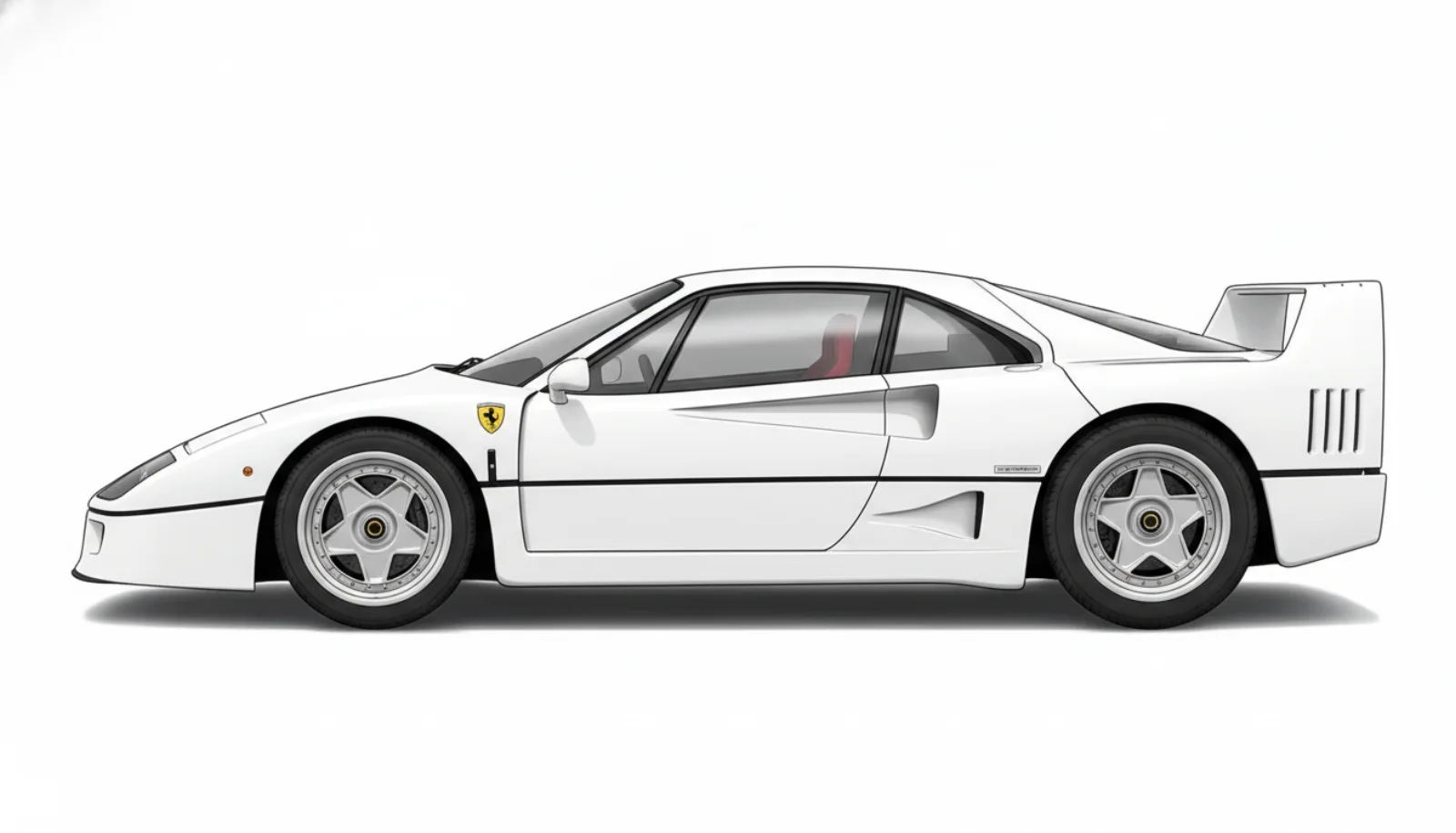
Illustrations are generated from period references and shown in the selected factory color; they are not photographs.
Where it was built
Italy · 1987–1992
Ferrari factory
Maranello
The factory, what else it built →
Italy · 1988–1994
Michelotto (F40 LM and Competizione race cars)
Padova
Where the cars went
- United States, 1990–1992: US-specification cars, per Marcel Massini's research as quoted by auction catalogues. RM Sotheby's words it as cars specified and delivered to North America.
- United Kingdom, 1988–1992: PistonHeads: around 78 are thought to have originally reached the UK, all left-hand drive. DK Engineering counts 58 UK-supplied catalyst cars with mph speedometers.
Against its rivals
Same class, same years. Each rival is shown in the specification and year a buyer would have cross-shopped.
Longer is better. Figures are for the variant and year named under each car, from the sources listed below.
In the comparison
Porsche 959 · 1987 · Germany
The other 1980s technical flagship: twin-turbo flat-six, four-wheel drive and electronics where the F40 had none.
Lamborghini Countach 25th Anniversary · 1988 · Italy
Italy's other mid-engined flagship on sale when the F40 reached customers, with a carburetted 5.2-litre V12.
Lamborghini Diablo · 1990 · Italy
Sant'Agata's 200 mph answer, launched while the F40 was still in production.
Bugatti EB110 GT · 1991 · Italy
Quad-turbo V12 and four-wheel drive from Campogalliano, aimed at the same buyers at the top of the market.
Jaguar XJ220 · 1992 · United Kingdom
Twin-turbo V6 limited-production supercar that took the outright top-speed claim as F40 production ended.
Factory options
| Option | Code | Years | Price | Built with it |
|---|---|---|---|---|
| Adjustable suspensionRide height can be raised or lowered by 20 mm. Offered from 1991; buying guides note the parts are now hard to find and costly. | — | 1991–1992 | — | — |
| Sports gearboxNon-synchromesh five-speed gearbox. | — | — | — | — |
| Schedoni fitted luggageThree-piece fitted luggage set by Schedoni. | — | — | — | — |
Known issues
Oil leaks near hot turbochargers
1987–1992safetyCam covers and turbo oil and coolant pipes are known leak points. Oil reaching the turbochargers or exhaust can ignite, so leaks need immediate attention. Smoke on start-up or under load points to worn turbochargers.
Fix Reseal cam covers and replace perished pipes; rebuild turbochargers that smoke.
Rubber fuel bag tanks perish
1987–1992majorEuropean cars carry fuel in two rubber safety cells that degrade with age and can leak. Ferrari recommends replacing them every ten years. US-specification cars have aluminium tanks and avoid the problem.
Fix Replace both cells on schedule and check the date of the last change in the service record; some owners fit aluminium tanks.
Cambelt changes are time-based
1987–1992moderateThe cam belts need replacing every two years or 6,000 miles regardless of use. PistonHeads puts the job at about £2,000, with a routine service every 3,000 miles.
Fix Budget for belts on any car without a recent invoice.
Fuse board and fuel pump cover
1987–1992moderateThe fuse board is a recognised weak point and the plastic fuel pump cover is prone to breaking.
Fix An uprated fuse box and an aluminium fuel pump cover are accepted upgrades.
Short clutch life
1987–1992moderateThe twin-plate clutch can last about 20,000 miles with care but as little as 5,000 with town driving or hard standing starts. Replacement is about £4,000.
Fix Replace the clutch; check the invoice history.
Brake fade
1987–1992moderateThe unassisted brakes are regarded as the car's weak link and fade on track and sometimes in fast road use. A set of discs and pads costs more than £6,000.
Fix Many track-driven cars have been fitted with competition-specification brakes.
Composite body damage and thin paint
1987–1992moderateThe carbon-Kevlar panels are costly to repair. The colour coat was applied thinly, so the weave showing through is normal; most cars have been repainted. The front splitter is easily damaged, the underside of the engine cover can show stress cracks, and the Perspex engine cover and Lexan windows scratch.
Fix Inspect panels and chassis tubes for cracks; original green sealant along panel joints is a sign of an unrestored or correctly restored car.
How it was advertised
The F40 was effectively not advertised. Built to mark Ferrari's 40th anniversary and the last car Enzo Ferrari personally approved, it was revealed to the press at the civic centre in Maranello on 21 July 1987, brought forward more than two months from the planned Frankfurt show debut at Enzo's insistence. With a price of roughly US$400,000 and demand far beyond the 400 cars first planned (production ended at about 1,311–1,315), Ferrari had no need to buy space for it; speculators were reselling cars at several times list price by 1989.
Promotion took the form of the launch, a factory documentary film that interwove archive interviews with Enzo Ferrari, scenes from the factory and the F40 driving through Modena, and television: Formula One driver Michele Alboreto drove the car in a Christmas 1987 special on Italian TV, and journalist Ezio Zermiani was filmed driving it from Maranello to Milan. Answering criticism that the car was a money-making exercise, Ferrari's marketing department said it was built for its most enthusiastic owners. No print or broadcast advertising campaign for the F40 was found.
Where it ran: 3 documented placements
More advertisements, viewable at their source (2)
These are still under copyright, so we describe them and link to where they can be seen rather than reproduce them.
- 1987F40 unveiled at Maranelloother · 1987-07-21 · Wikipedia ↗The press unveiling at Maranello's civic centre for Ferrari's 40th anniversary, staged ahead of the Frankfurt show at Enzo Ferrari's request; the event took the place of a launch campaign.
- 1987Ferrari F40 promotional filmother · Internet Archive ↗Factory promotional documentary combining archive interviews with Enzo Ferrari, footage from the works and the F40 on the road around Modena. A copy is posted on the Internet Archive.
The F40 was barely advertised, and saying so is the finding: no Ferrari magazine, newspaper or television advertisement for it was found on Wikimedia Commons, in the AHPS library or in the Internet Archive collections checked. The Internet Archive upload of the 1987 promotional film was made by a private user who cites Ferrari social-media posts as the source; it was not viewed, and its identity with the documentary Wikipedia describes is assumed, not confirmed. Factory sales brochures for the F40 were not located; the web-search budget for this run ran out before they could be searched for. Third-party ads featuring the car (tyre, oil or model makers) were not searched for either.
Sources
- 1Ferrari F40 (1987) — Ferrari S.p.A. factory
- 2Enzo's dream (History, 1987) — Ferrari S.p.A. factory
- 3Ferrari F40 Competizione (1989) — Ferrari S.p.A. factory
- 4Ferrari F40 registry — Dacorsa registry
- 5Ferrari F40 LM chassis list — Dacorsa registry
- 6Ferrari F40: the collection — radical-mag.com reference
- 7Everything You Need to Know about the Ferrari F40 — Sotheby's auction
- 81992 Ferrari F40, chassis 93103 (Amelia Island 2021) — RM Sotheby's auction
- 9Ferrari F40 Guide — Supercar Nostalgia reference
- 10Ferrari F40 / F40 LM / F40 GTE chassis 74045 — Supercar Nostalgia reference
- 11Ferrari F40 LM (1991) — DK Engineering reference
- 12Ferrari F40 (vehicle archive 452) — DK Engineering reference
- 13Ferrari F40 (1991), UK-supplied catalyst car — DK Engineering reference
- 14Ferrari F40 (1990), prototype — DK Engineering reference
- 15The Official Ferrari F40 Picture and Info Thread, page 52 (production recap by chassis and build date) — Teamspeed.com forum reference
- 161990 Ferrari F40 US-Spec — Supercars.net reference
- 17Ferrari F40 (1987–92) — AutoZine reference
- 18Ferrari F40: review, history, prices and specs — Evo reference
- 19Ferrari F40: buying guide and review (1987–1992) — Auto Express reference
- 20Ferrari F40: PH used buying guide — PistonHeads reference
- 21Ferrari F40 — Wikipedia (English) reference
- 22Ferrari F40 — Wikipedia (Italian) reference
- 23Ferrari F40 — Wikipedia (German) reference
- 24Countach 25th Anniversario — International Lamborghini Registry registry
- 25Porsche 959 — Wikipedia (English) reference
- 26Lamborghini Diablo — Wikipedia (English) reference
- 27Bugatti EB 110 — Wikipedia (English) reference
- 28Jaguar XJ220 — Wikipedia (English) reference
Research notes: what is not documented, and where sources disagree (15)
- Production by year is not documented by Ferrari or by any registry opened for this research, so every modelYears.units is null. The only year-by-year figures found are an enthusiast tally from chassis and build-date lists (Teamspeed forum, 2008): 1987: 7; 1988: at least 79; 1989: at least 301; 1990: at least 365 European plus 93 US; 1991: at least 302 plus 58 US; 1992: at least 110 plus 60 US. Those figures add up to more than Ferrari's 1,311 and their author says they do not reconcile, so they are recorded here and not in the data.
- Total production: Ferrari's own page says 1,311 cars left the factory. RM Sotheby's, PistonHeads, Motor Sport, Auto Express and German Wikipedia use 1,315. It is not documented whether either figure includes the Michelotto LM and Competizione chassis, which carry numbers from the same sequence.
- US-specification cars: 213 is consistent across sources (attributed to Marcel Massini's research). The split by model year is not settled: auction catalogues say about 90 cars for 1990 and 60 for 1992; the Teamspeed build-record tally gives 93, 58 and 60, which adds up to 211. DK Engineering's listings say about 600 cars were bound for the USA, which conflicts with every other source and was not used.
- Deliveries by country: no registry or factory breakdown was found, so only the US figure and the approximate UK figure are in markets. Dealer listings (Tom Hartley Jnr) state 171 cars delivered new to Germany and 100 to Switzerland; these could not be traced to a registry and were left out.
- Left- and right-hand drive: all sources agree the factory built left-hand drive only, so driveSide is 1,311 and 0. The roughly seven right-hand-drive cars were post-factory conversions for the Sultan of Brunei.
- Price when new: Italy 380 million lire per Ferrari, about 374 million per Italian Wikipedia (citing a book); a DK Engineering listing quotes 202.6 million lire for one car supplied in Italy in February 1990, which does not fit either figure and was not used. UK: £163,000 (Auto Express, AutoZine, Octane), £160,000 landed (PistonHeads), £193,000 (Evo) and about £250,000 (Motor Sport). US: $399,150 (Car and Driver, via Sotheby's), about $385,000 (Sports Car Market), $415,000 (Supercars.net). No period price list was opened directly.
- Timing of catalysts and adjustable suspension: DK Engineering, PistonHeads and Auto Express date both to 1991; individual cars documented by auction catalogues show catalysts on a European car delivered in May 1990 and at least one non-catalyst car with a later chassis number. No chassis number for the changeover is documented.
- Sliding-window cars: 'about the first 50' is consistent across sources; the end point at chassis 77088 comes from Italian Wikipedia only.
- Power of the catalysed and US engines is inconsistent between sources: 478 hp (RM Sotheby's), 484 PS or 484 bhp (Wikipedia, Supercar Nostalgia), 515 bhp (Supercars.net). Ferrari publishes only the 478 hp figure.
- Weight: Ferrari quotes 1,100 kg dry. The 2,765 lb (1,254 kg) used for the European car is the fuelled test weight published by auto motor und sport; Supercar Nostalgia quotes 1,202 kg. The US car's 3,018 lb is the figure attributed to Car and Driver.
- Top speed: 201 mph (324 km/h) is Ferrari's claim. Independent tests in period recorded 321 km/h (Sport Auto 1988, auto motor und sport 1989), 197 mph (Car and Driver 1991) and 196 mph (Road & Track 1991). The Car and Driver, Road & Track and Motor Trend pages could not be opened directly; their figures are taken as reported by Wikipedia, AutoZine and Sotheby's.
- Racing cars: Ferrari's page says around ten LM and Competizione cars were built in total; the Dacorsa list of Michelotto build numbers shows 19 LM chassis (18 new plus the converted pre-production car 74045); Italian Wikipedia gives 2 LM, 8 Competizione and 7 GTE. The LM variant carries the Michelotto count of 19 and the Competizione unit count is left null because the two overlap.
- Colour: sources agree on Rosso Corsa only. German Wikipedia mentions two black, fewer than ten yellow and one white car as delivered; this is unsourced there and conflicts with the other references, so it is not in colors. No factory paint code was documented.
- Options: no period option list with codes or prices was found. Whether the seats were offered in different sizes could not be documented. Supercar Nostalgia's guide and the other sources disagree on air conditioning; Wikipedia, Sotheby's and PistonHeads describe it as fitted, which is what is recorded.
- Torque for the F40 LM and Competizione, and 0–60 mph times for both, were not found.
28 sources. Paint swatches are screen approximations of the factory colors.