Mercedes-Benz300 SL
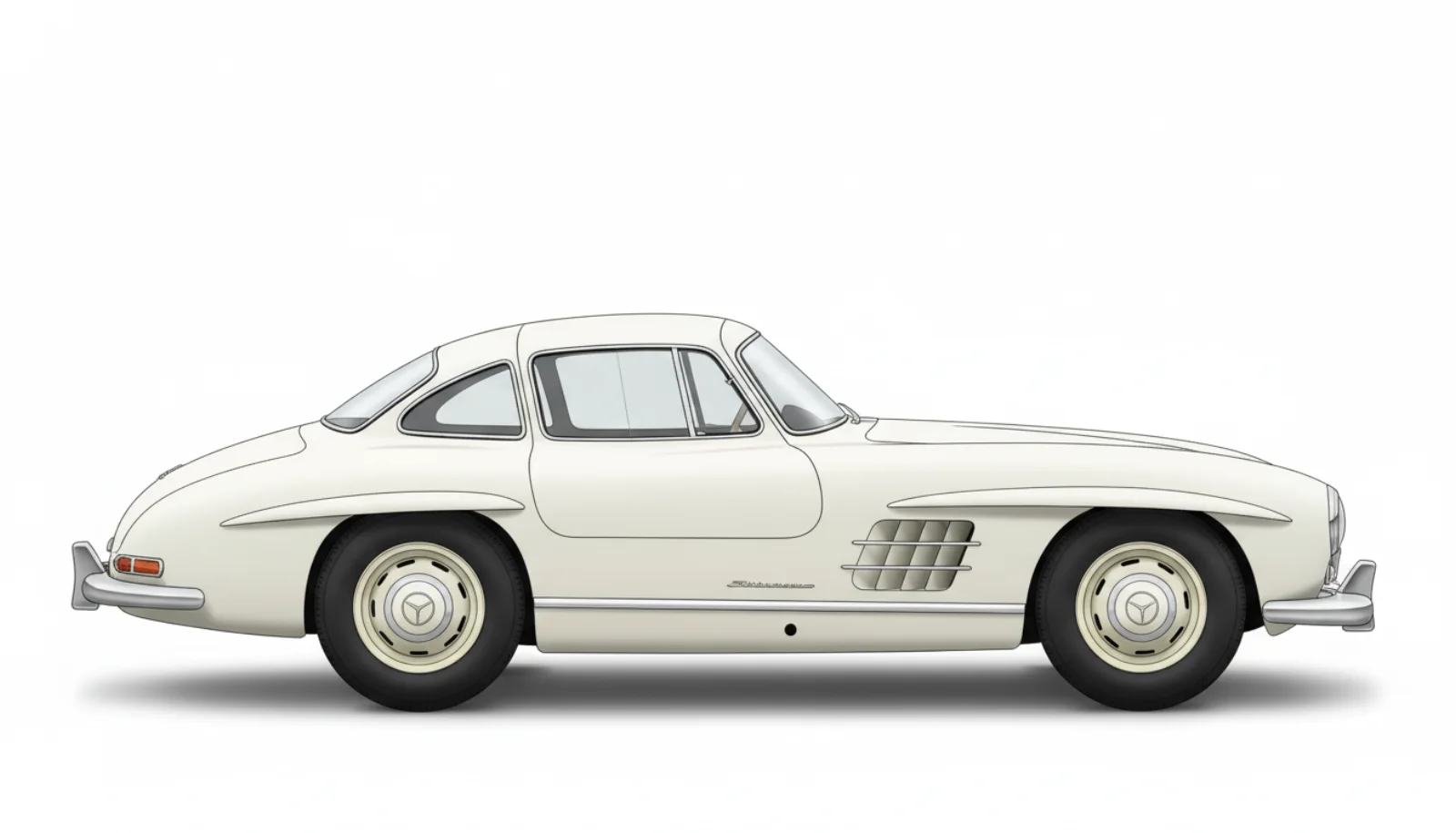
Silver Grey Metallic · DB 180 · 1954–1957
Screen approximation of the factory paint
Model year
Generation
Coupé 'Gullwing' (W 198 I)
Built in 1954
Built in all, 1954–1963
Serial numbers, 1954
Coupé, 1954 build (45-series numbers): earliest number documented198.040.4500012 → …
Price new, 1954
DM 29,000
Germany
Origin
Germany
Front-engine, rear-wheel drive
A road-going development of the 1952 Le Mans winner, sold first as a gullwing coupé and then as a roadster.
Sports car23 sources
How it launched in 1954
- 01Shown at the International Motor Sports Show in New York in February 1954 alongside the 190 SL; series production began at Sindelfingen in August 1954.
- 02Launch specification: tubular space frame, roof-hinged doors, 2,996 cc injected six rated at 215 hp DIN, four-speed gearbox, finned drum brakes with a vacuum servo, swing-axle rear suspension.
- 03Changes from the show car: quarter-lights in the doors, revised door catches, a two-spoke steering wheel, repositioned clock and switches, heater and ventilation levers.
- 04Final drive changed from 3.42:1 to 3.64:1 at the 41st car.
- 05From the 51st car the long gear lever acting directly on the gearbox was replaced by a shorter lever with a remote linkage.
- 06The first cars were sold in Europe. Price in Germany DM 29,000.
Coupé 'Gullwing' (W 198 I), 1954–1957
The production version of the 1952 W 194 racing coupé, built at Sindelfingen from August 1954 to May 1957. Its tubular space frame rises so high along the sills that the doors had to be hinged in the roof. The 3.0-litre six, canted over to fit under the bonnet, was the first four-stroke production car engine with direct petrol injection. 1,400 were built, 29 of them with an all-aluminium body.
Built, this generation 1,400
Body styles by year
Trim lines and engines, 1954
| Line | Power | Torque | 0–60 mph | Top speed | Weight |
|---|---|---|---|---|---|
2,996 cc M 198 I overhead-camshaft straight-six, inclined to the left, Bosch mechanical direct fuel injection, dry-sump lubrication | 215 hp | 203 lb-ft | 8.8 s | 135 mph | 2,855 lb |
300 SL Coupé
1954–1957
- Engine
- 2,996 cc M 198 I overhead-camshaft straight-six, inclined to the left, Bosch mechanical direct fuel injection, dry-sump lubrication
- Displacement
- 2,996 cc
- Layout
- I6 · naturally aspirated · RWD
- Power
- 215 hp (DIN, at 5,800 rpm (Mercedes-Benz archive). US literature quoted 240 hp SAE gross.)
- Torque
- 203 lb-ft
- 0–60 mph
- 8.8 s — The Autocar road test, 1955, which also recorded 0-100 mph in 21.0 s and the 135 mph top speed shown. The factory quoted up to 260 km/h with the tallest axle ratio.
- Top speed
- 135 mph
- Weight
- 2,855 lb
- Gearboxes
- 4-speed manual, all-synchromesh
- Length × width × height
- 178 × 70.5 × 51.2 in
- Wheelbase
- 94.5 in
- Body styles
- Coupé, steel body with aluminium bonnet, doors and boot lid (type 198.040)
- Price new
- DM 29,000 (1954, Germany)
- Built
- 1,371
What this line added
- Silver-grey paint; any other colour cost extra
- Plaid cloth seats; leather optional
- Tilting steering wheel to ease entry
- Removable side windows with opening quarter-lights
- Vacuum brake servo on finned drum brakes
- Final drive 3.64:1 from the 41st car, with 3.25, 3.42, 3.89 and 4.11 available
- Sports camshaft engine available at no extra cost
Factory colors, 1954
3 of 7 documented colors were offered this year. Pick one to repaint the page.
Interiors, 1954
Units built by year
Left- and right-hand drive
The split is not documented.
All 1,400 coupés were left-hand drive. No statement of the Roadster's drive-side split was found, so totals are left open.
1,400 coupés (August 1954 to May 1957) and 1,858 Roadsters (1957 to February 1963), per Mercedes-Benz.
Price when new
Lowest list price each year in Germany, in DEM of the day. Not adjusted for inflation.
Serial number ranges
| Series | Drive | Years | From | To |
|---|---|---|---|---|
| Coupé, 1954 build (45-series numbers): earliest number documentedChassis numbers consist of the type (198.040 steel, 198.043 light alloy), a two-digit year group (45 on 1954 cars, 55 on 1955 cars, 65 on 1956 cars) and a five-digit serial. The first and last number of each year were not found. 4500012 was completed on 24 September 1954; 4500144 is the highest 1954 number shown on the register's pages. | LHD | 1954 | 198.040.4500012 | … |
| Coupé, 1955 build (55-series numbers): lowest number seenNot the first number of the year. Highest steel-bodied number seen: 5500840. The glass-fibre car is 5500028. | LHD | 1955 | 198.040.5500098 | … |
| Coupé, 1956 build (65-series numbers): lowest number seenNot the first number of the year. 6500024 was the Geneva show car of March 1956. | LHD | 1956 | 198.040.6500019 | … |
| Coupé, light-alloy body: example numberThe 16th of the 29 alloy-bodied cars according to the register. Alloy cars share the serial sequence with the steel cars; no list of all 29 numbers was found. | LHD | 1955 | 198.043.5500426 | … |
| Roadster with disc brakes, from March 1961 (first number)Late Roadsters use the form 198.042.10.00xxxx. The serial continues the count begun with the coupé. | — | 1961–1962 | 198.042.10.002780 | … |
| Roadster with light-alloy block, from March 1962 (first number)198.042.10.003255 is documented as the fourth from last Roadster built, which would make the last car 003258, equal to 1,400 coupés plus 1,858 Roadsters. The last number itself was not seen in a source opened. | — | 1962–1963 | 198.042.10.003049 | … |
The car
The 300 SL (W 198) grew out of the W 194 racing coupé that won Le Mans and the Carrera Panamericana in 1952. The US importer Max Hoffman pressed Daimler-Benz for a production version, and the car was shown in New York in February 1954 rather than at a European show. Production began at Sindelfingen that August.
It kept the racing car's tubular space frame, which runs so high along the sills that the coupé's doors had to open upwards. The 3.0-litre straight-six was laid over to the left to lower the bonnet and was the first four-stroke production car engine with direct petrol injection, giving 215 hp DIN. Depending on axle ratio the factory claimed up to 260 km/h, which made it the fastest production car of its day.
1,400 coupés were built to May 1957, 29 of them with all-aluminium bodies. Most went to the United States. The Roadster that replaced it had a redesigned frame with normal doors, a boot and a better rear axle; it gained disc brakes in 1961 and an alloy engine block in 1962, and 1,858 were built before production ended on 8 February 1963.
- Class
- Sports car
- Layout
- Front-engine, rear-wheel drive
- Origin
- Germany
- Designers
- Friedrich Geiger, Rudolf Uhlenhaut (engineering)
- Also known as
- W 198, Gullwing, Flügeltürer, Papillon, 300 SL Roadster
- In production
- 1954–1963
Milestones
- 1952
The W 194 racing 300 SL wins the Le Mans 24 Hours and the Carrera Panamericana.
- 1954
Production 300 SL shown in New York in February; series production starts at Sindelfingen in August.
- 1955
First car exported to the United States in March. Class win on the Mille Miglia, European Rally Championship for Werner Engel, SCCA class title for Paul O'Shea.
- 1956
Willy Mairesse wins the Liège-Rome-Liège rally, as Olivier Gendebien had in 1955.
- 1957
Roadster shown at Geneva in March; the last coupé is built in May. Paul O'Shea wins the SCCA Class D title with the 300 SLS.
- 1958
Removable hardtop offered from October.
- 1961
Dunlop disc brakes on all four wheels from March.
- 1962
Light-alloy cylinder block from March.
- 1963
Last 300 SL built on 8 February.
- 1999
Voted sports car of the century by readers of Motor Klassik.
Pictures
Illustrations are generated from period references and shown in the selected factory color; they are not photographs.
Where it was built
Where the cars went
- United States, 1954–1957: Coupés only: about 1,100 of the 1,400 went to the United States. Mercedes-Benz Classic material, as quoted by a secondary source, says 850 of the 996 coupés built in 1954 and 1955 went to the US and that more than half of all 300 SLs had gone to North America by 1963.
Against its rivals
Same class, same years. Each rival is shown in the specification and year a buyer would have cross-shopped.
Longer is better. Figures are for the variant and year named under each car, from the sources listed below.
In the comparison
BMW 507 · 1957 · Germany
The other Max Hoffman-inspired German sports car, a V8 roadster priced close to the 300 SL.
Jaguar XK150 S 3.4 fixed-head coupé · 1959 · United Kingdom
Comparable performance for about half the money.
Ferrari 250 GT Coupé Pinin Farina · 1958 · Italy
A 3.0-litre V12 grand tourer for the same clientele.
Aston Martin DB4 · 1960 · United Kingdom
A British six-cylinder GT that arrived as the Roadster was in mid-life.
Maserati 3500 GT · 1958 · Italy
An Italian straight-six GT sold in similar numbers.
Factory options
| Option | Code | Years | Price | Built with it |
|---|---|---|---|---|
| Paint other than metallic silver | — | — | $65 | — |
| Leather upholstery (coupé) | — | 1954–1957 | $165 | — |
| Rudge centre-lock wheels, set of five | — | — | $350 | — |
| Becker radio | — | — | $264 | — |
| Bumper guards, set of four | — | — | $40 | — |
| Windscreen washers | — | — | $18 | — |
| Competition springs, set of four | — | — | $88 | — |
| Competition front dampers, pair | — | — | $41 | — |
| Competition rear dampers, pair | — | — | $85 | — |
| Competition camshaftThe sports camshaft engine could also be ordered from new at no extra cost on the coupé and was standard on the Roadster. | — | — | $73 | — |
| Alternative final drive ratio, per set3.25, 3.42, 3.89 or 4.11 in place of the standard 3.64 (no 4.11 on the Roadster). | — | — | $80 | — |
| Crated shipment from the factory | — | — | $80 | — |
| Fitted luggage (Roadster) | — | 1957–1963 | $85 | — |
| Removable hardtop (Roadster)Offered from October 1958 and soon the most ordered option. The US option list reproduced on Wikipedia gives USD 178. | — | 1958–1963 | DM 1,500 | — |
| All-aluminium body (type 198.043)With Plexiglas windows, Rudge wheels and competition suspension. | — | 1955–1957 | — | 29 |
| 130-litre fuel tank (coupé) | — | 1954–1957 | — | — |
Known issues
Swing-axle handling on the coupé
1954–1957safetyThe coupé's high-pivot two-joint swing axle allows large camber changes, which can make the rear end treacherous in fast cornering or on poor roads.
Fix The Roadster's single-joint low-pivot axle with compensating spring greatly improved matters; it was not fitted to the coupé.
Oil dilution from the fuel injection
1954–1963majorThe mechanical injection pump keeps delivering fuel while the engine runs down after the ignition is switched off. The petrol washes oil from the cylinder walls and thins the oil, causing ring and bore wear. The large dry-sump oil system and oil cooler also keep the oil too cool on short journeys.
Fix Period practice was to blank off part of the oil cooler in cool weather and change the oil at the recommended 1,000-mile interval; avoid short trips and over-use of the auxiliary fuel pump.
Tubular frame damage and corrosion
1954–1963majorAccident repairs and corrosion in the space frame are costly to put right, and restoration runs well into six figures.
Fix Have a 300 SL specialist inspect the frame, and check chassis, engine and body numbers against the factory data card.
Heat and ventilation in the coupé
1954–1957minorThe cabin gets hot in summer. The side windows do not wind down and can only be lifted out and stowed behind the seats, leaving the quarter-lights and a scuttle vent for airflow.
Heavy clutch on early cars
1954–1955minorClutch pedal effort was high at first.
Fix The factory fitted an improved helper spring on the clutch arm.
How it was advertised
The 300 SL was sold first on its racing record and through Max Hoffman, the New York importer who had pushed Daimler-Benz to build a road car and who sold more than 1,000 of the roughly 1,400 gull-wing coupes. The production car made its public debut at the International Motor Sports Show in New York in February 1954, before it was shown in Europe. Factory advertising for the coupe was modest and restrained compared with the 1952 racing posters by Hans Liska: a French ad drawn like a copperplate engraving placed the car before the Arc de Triomphe, and the 1955 sales brochure, illustrated in ink by the company's long-serving advertising artist Walter Gotschke, presented the gull-wing as a racing car made fit for the road.
The Roadster launched at Geneva in March 1957 with a campaign by the Heimann agency built around a crouching tiger and the theme of elegantly controlled power. English-language ads of 1958 and 1961 sold it as part of the wider Mercedes-Benz range, on quality and on the company's heritage back to the 1886 Benz Patent Motorwagen. From 1958 to 1963 Mercedes-Benz cars in the United States were distributed by Mercedes-Benz Sales Inc., a Studebaker-Packard subsidiary, through Studebaker dealers; enthusiast magazines such as Sports Cars Illustrated (later Car and Driver) carried 300 SL Roadster ads in this period. No television advertising for the car was found.
Where it ran: 8 documented placements
More advertisements, viewable at their source (9)
These are still under copyright, so we describe them and link to where they can be seen rather than reproduce them.
- 1954300 SL before the Arc de Triomphemagazine · eMercedesBenz ↗A black-and-white French ad drawn to look like a copperplate engraving, standing the gull-wing coupe in front of the Arc de Triomphe; far more sober than the racing posters that preceded it.
- 1955300 SL sales brochure (Walter Gotschke illustration)brochure · eMercedesBenz ↗Sales brochure with an ink drawing by Walter Gotschke of a silver gull-wing against a blue ground; the text presents the car as the road-going version of the 1952 racing 300 SL.
- 1957Elegantly controlled powermagazine · Mercedes 500SEC.com ↗Launch campaign for the Roadster: a crouching tiger circles the open car, a painterly image promising excitement held in check.
- 1958The 300 SL Roadster: A rare combination: outstanding road performance plus luxurymagazine · Sports Cars Illustrated · 1958-01 · Car and Driver (via AOL) ↗Black-and-white line drawing of the Roadster framed in a black panel, with sketched details of the dashboard, seats and racing W 196 around it. The copy ties the car to the 300 SLR and W 196 racers, then turns to its luxury touches (wind-up windows, leather buckets, quick top). Signed off by Studebaker-Packard, which distributed and serviced Mercedes-Benz cars in the US. Reproduced in Car and Driver's gallery of the best car ads of the 1950s and 1960s.
- 1958Anyway you look at it – qualitymagazine · eMercedesBenz ↗A 300 SL Roadster with a headscarfed passenger overtakes a 180 Ponton saloon; the copy argues that the same quality runs through every Mercedes-Benz, from the sports car to the family sedan.
- 1959Mercedes-Benz is a most ingenious paradoxmagazine · Internet Archive (Car Brochures & Adverts collection) ↗A red 300 SL Roadster at a white colonial house, framed by the three-pointed-star mascot of a sedan in the foreground; the copy uses the contrast between the sports car and the family sedan to argue that every Mercedes-Benz shares the same quality. Placed by Mercedes-Benz Sales, Inc., a subsidiary of Studebaker-Packard.
- 1959Mercedes-Benz Type 300 SL Roadster: Motoring Pleasure Personifiedbrochure · Internet Archive (Car Brochures & Adverts collection) ↗US sales leaflet in black, white and bright blue with photographs of the Roadster with soft top and with the optional hardtop, and short copy on its performance and new headlamp units.
- 1961There's one thing unchanged by timemagazine · eMercedesBenz ↗Anniversary-year ad pairing a 300 SL Roadster with the 1886 Benz Patent Motorwagen, linking them through the urge to travel faster.
- 1962New dimensions of beauty — the streamlined Mercedes-Benz 300SL convertible and our own Sophie's luminous white columnmagazine · Vogue · 1962-09-15 · Internet Archive (Car Brochures & Adverts collection) ↗Not a Mercedes-Benz ad but a Saks Fifth Avenue fashion ad: a woman in a beaded white evening gown waits under a modern canopy while a doorman opens a black 300 SL Roadster, the car used as the emblem of streamlined luxury.
No period 300 SL advertisement with a public-domain or open licence was found on Wikimedia Commons or in a museum open-access collection; all entries are link-only. Internet Archive items are collectors' group uploads with no licence statement; their dates are as given in the item titles. The 1958 and 1961 ads are described by the source only as English-language; the US market is assumed from the distribution arrangement and has not been confirmed against a named publication. The January 1958 Sports Cars Illustrated ad is a different layout from "Anyway you look at it – quality" and is signed by Studebaker-Packard, confirming the distribution arrangement was already advertising the car in January 1958. No agency is named for the US advertising placed by Hoffman or by Mercedes-Benz Sales Inc. (Studebaker-Packard); the only agency documented is Heimann for the 1957 Roadster launch. Both heritage summaries consulted (eMercedesBenz 2012 and 500SEC.com) appear to derive from the same Daimler heritage text on SL advertising; the original Daimler release was not located.
Sources
- 1300 SL (W 198 I), 1954-1957: technical data, units produced and price — Mercedes-Benz Public Archive (Mercedes-Benz AG) factory
- 2300 SL Roadster (W 198 II), 1957-1963: technical data, units produced and price — Mercedes-Benz Public Archive (Mercedes-Benz AG) factory
- 3Types 300 SL Coupé and 300 SL Roadster (W 198), 1954-1963: model series history — Mercedes-Benz Public Archive (Mercedes-Benz AG) factory
- 4Mercedes-Benz 300 SL Coupé / Gullwing Register #198.040 & #198.043 (Register No. 2 and No. 3 pages) — Eric Le Moine, Archives ELM, Geneva registry
- 5Mercedes-Benz 300 SL (production table citing Adler 1994 and Nitske; option prices citing Sports Cars Illustrated, April 1956) — Wikipedia reference
- 6Mercedes-Benz W 198 — Wikipedia (German) reference
- 7March 1957: The SL Legacy Begins — Mercedes Heritage reference
- 8300SL Gullwing & Roadster 1954-1962: production numbers and buying notes — Silver Star Restorations reference
- 9Guide: Mercedes-Benz W198 300 SL Gullwing — Supercar Nostalgia reference
- 10FAQ: Mercedes-Benz W198 300 SL Gullwing — Supercar Nostalgia reference
- 11Guide: Mercedes-Benz W198 300 SL Roadster — Supercar Nostalgia reference
- 12Throwback Thursday: 1955 Mercedes-Benz 300 SL road test — Autocar period-test
- 13Mercedes-Benz 300 SL Roadsters, 1958 and 50 years hence (summary of the Road & Track road test of January 1958) — Simanaitis Says period-test
- 141955 Mercedes-Benz 300 SL Gullwing, Arizona 2022 catalogue entry — RM Sotheby's auction
- 15Mercedes-Benz 300 SL history: the Gullwing coupe and the roadster (citing Mercedes-Benz Classic press information, August 2021) — CarWhere Research reference
- 16Mercedes-Benz 300 SL Roadster chassis 198.042.10.003255 — Ultimatecarpage.com reference
- 17CMC Mercedes-Benz 300 SL (W 198) hardtop, white DB 050: product notes on colour frequency — CMC Modelcars reference
- 18Mercedes-Benz paint codes (Martin Senour paint chip sheet, 1958-1965) — International Ponton Owners Group (mbzponton.org) club
- 19BMW 507 — Wikipedia reference
- 20Jaguar XK150 — Wikipedia reference
- 21Ferrari 250 GT Coupé — Wikipedia reference
- 22Aston Martin DB4 — Wikipedia reference
- 23Maserati 3500 GT — Wikipedia reference
Research notes: what is not documented, and where sources disagree (13)
- Production by year: two different splits are published and both add up to 1,400 and 1,858. This dossier uses the one on English Wikipedia, cited there to the marque books by Adler and Nitske: coupé 166 / 856 / 308 / 70; Roadster 618 / 267 / 200 / 241 / 256 / 182 / 94. Silver Star Restorations gives coupé 146 / 867 / 311 / 76 and Roadster 554 / 324 / 211 / 249 / 250 / 244 / 26 without naming a source. The second set looks like calendar-year build figures (26 cars before production stopped on 8 February 1963 is more plausible than 94), so this needs a human check against the factory record or the Engelen books. The Mercedes-Benz archive gives only the totals.
- Mercedes-Benz Classic press material, as quoted by CarWhere, says 996 coupés were built in 1954 and 1955, which matches neither split (1,022 or 1,013). The Le Moine register site says more than 1,000 had been built by the end of December 1955, of which 930 were exported.
- Coupé body count: the Mercedes-Benz archive says 1,400 including 29 light-alloy cars and mentions one test car with a plastic body. Mercedes Heritage lists 1,371 coupés, 29 alloy and one glass-fibre car, which would be 1,401. Steel-bodied units are entered as 1,371.
- Chassis numbers: no year-by-year first and last numbers were found for either body. The entries give the numbering pattern and the earliest or lowest numbers seen in opened sources, plus the two documented Roadster change points (disc brakes from 002780, alloy block from 003049). Roadster numbers before the 198.042.10.00xxxx form (75- and 85-series) and 1957 coupé numbers are not listed because none was seen in a source opened. The Le Moine register books hold the complete data.
- Colours: no source opened lists the factory colour range with DB codes for the 300 SL, and none gives units per colour. RM Sotheby's says buyers chose from ten standard colours and that some 530 coupés were silver; CMC says almost every fifth car was white and that 40 colours were used on one car each. Only colours tied to the 300 SL by an opened source are listed. DB codes are taken from a general Mercedes-Benz paint chip sheet published by the Ponton owners' group, matched by colour name, not from a 300 SL document. Years shown are the production span of the body on which the colour was documented. Colours such as Fire Engine Red (DB 534), Strawberry Red Metallic (DB 543) and Light Blue (DB 334) appear on that chip sheet but could not be tied to the 300 SL here.
- Deliveries by country: only the United States share of the coupé is documented, and only approximately (about 1,100 of 1,400; other sources say around 80 per cent). No per-country figures for other markets or for the Roadster were found.
- Power: the Mercedes-Benz archive gives 215 hp at 5,800 rpm for both bodies. German Wikipedia says the standard camshaft gave 200 PS and the sports camshaft 215 PS; English Wikipedia gives 240 hp SAE gross and 212 hp DIN; Supercar Nostalgia quotes 240 bhp for the sports engine. The archive figure is used.
- Weights: the archive gives 1,295 kg for the coupé and 1,330 kg for the Roadster (DIN kerb weight). German Wikipedia gives 1,420 kg for the Roadster and Supercar Nostalgia 1,390 kg. The weight saving of the alloy body is given as 80 kg by Wikipedia and 130 kg by Supercar Nostalgia and CarWhere, so the alloy car's weight is left null.
- Alloy-block Roadsters: 209 is the number given by both Wikipedia editions; chassis 003049 to 003258 would be 210 cars, and other sources quote 210 or 218. English Wikipedia dates the alloy block to March 1963, which is a slip; the factory says March 1962.
- Performance: period tests differ widely. Autocar (1955) recorded 0-60 mph in 8.8 s and 135 mph; Road & Track's 1955 test is quoted second-hand at 7.4 s and could not be opened. The Roadster figure is Road & Track's 7.0 s from January 1958 as summarised by a former R&T editor. The factory's own figure is 0-100 km/h in 10 s.
- Prices: German factory prices are from the Mercedes-Benz archive. US prices come from Wikipedia (USD 6,820 coupé and USD 10,950 Roadster, citing Nitske and the Standard Catalog of Imported Cars) and from the 1958 Road & Track test (USD 10,970). The US option prices are from a list Wikipedia attributes to Sports Cars Illustrated, April 1956; that date is before the Roadster existed although the list includes Roadster items, so the attribution should be checked.
- The hardtop is dated October 1958 by the Mercedes-Benz archive and September 1958 by Wikipedia. The end year of alloy-body coupé production is not documented; the variant is shown to 1957.
- Interior: leather colours were not documented beyond individual cars.
23 sources. Paint swatches are screen approximations of the factory colors.