Model year
Generation
Early series (zenki), MF10 and MF10L
Built in 1966
Built in all, 1967–1970
Serial numbers, 1966
Early series, all cars (MF10 and MF10L share one sequence)MF10-10001 → MF10-10238
Price new, 1966
Not documented
Origin
Japan
Front mid-engine, rear-wheel drive
A 2.0-litre twin-cam coupé engineered by Toyota and hand-built by Yamaha, 351 made between 1966 and 1970.
Sports carLHD 93RHD 25821 sources
How it launched in 1966
- 01Six cars carry 1966 dates in the production list, chassis 10001 to 10006, completed between 27 September and 7 December 1966. The list marks 10001, 10005 and 10006 as US competition cars (the Shelby team cars) and the others as special-purpose.
- 02A speed-trial car ran at the Yatabe proving ground in early October 1966 and set three world records and 13 international class records.
- 03Two pre-production cars without chassis numbers were converted into open cars for the Bond film at the Toyopet Service Center at Tsunashima, near Yokohama.
Early series (zenki), MF10 and MF10L, 1967–1969
The original car, on sale in Japan from 16 May 1967. The production list starts earlier, with six cars dated September to December 1966 that went to competition, test and special duties, three of them to the United States for the Shelby racing programme. Right-hand-drive MF10 and left-hand-drive MF10L cars share one chassis sequence, 10001 to 10238, in which five numbers have no entry. The last early cars are dated December 1968, although the model stayed on sale until the August 1969 facelift. During the run the front turn-signal lenses changed from white to amber. The two open cars built for You Only Live Twice were converted in 1966 from pre-production cars that had no chassis numbers and are not part of the 233.
Built, this generation 233
Body styles by year
Trim lines and engines, 1966
No trim line is documented for 1966.
Factory colors, 1966
0 of 10 documented colors were offered this year. Pick one to repaint the page.
Interiors, 1966
Units built by year
Fastback coupé, 1966
Open-top film car (You Only Live Twice), 1966
Left- and right-hand drive
84 left-hand-drive MF10L (RM Sotheby's; the production list shows 83 cars with the left-hand-drive type code 36011 plus MF10L-10487) and all nine MF12L. The remaining 258 are right-hand drive, which matches a count of the list when 10081 and 10082, labelled MF10L but carrying the right-hand-drive type code, are taken as right-hand drive.
Count of the Yamaha production list published by Shin Yoshikawa as reproduced at 2000gt.net: 233 early series, 109 late series and 9 MF12L 2.3-litre cars, pre-production and competition cars included. Toyota and Yamaha publish 337, which leaves out the MF12L. The two open Bond cars had no chassis numbers and are not counted.
Serial number ranges
| Series | Drive | Years | From | To |
|---|---|---|---|---|
| Early series, all cars (MF10 and MF10L share one sequence)238 numbers, 233 cars: 10022, 10042, 10211, 10212 and 10234 have no entry in the production list. Engine numbers do not follow chassis numbers. | — | 1966–1968 | MF10-10001 | MF10-10238 |
| Early series, left-hand drive, first block10081 and 10082 are labelled MF10L but carry the right-hand-drive type code 36010; 10083 onward carry 36011. | LHD | 1967 | MF10L-10081 | MF10L-10126 |
| Early series, left-hand drive, second block | LHD | 1967 | MF10L-10135 | MF10L-10148 |
| Early series, left-hand drive, single car | LHD | 1968 | MF10L-10184 | MF10L-10184 |
| Early series, left-hand drive, third blockThe page prints one all-blank spacer row after 10200, which is not a chassis. | LHD | 1967–1968 | MF10L-10186 | MF10L-10203 |
| Early series, left-hand drive, fourth block | LHD | 1968 | MF10L-10214 | MF10L-10219 |
| Late series, all MF10 (manual and MF10-C automatic share one sequence)109 cars. The list marks 17 as MF10-C automatics, 16 of them with type code 36040. Japanese Wikipedia also gives 10401 as the first true late-series number. | — | 1969–1970 | MF10-10401 | MF10-10509 |
| Late series, the one left-hand-drive carDelivered to El Salvador; listed with the right-hand-drive type code. | LHD | 1970 | MF10L-10487 | MF10L-10487 |
| MF12L 2.3, left-hand drive100001 and 100004 are MF12L-C automatics. 100002 is kept by Toyota. Japanese Wikipedia notes that accounts of the MF12L numbering vary. | LHD | 1969–1970 | MF12L-100001 | MF12L-100009 |
The car
The 2000GT was Toyota's first true sports car: a low two-seat fastback on a steel backbone chassis, with double wishbones and disc brakes at every wheel, a limited-slip differential, a five-speed gearbox and a 1,988 cc straight-six that paired the Crown's block with a twin-cam head developed with Yamaha. Toyota laid out and styled the car in-house under Jiro Kono, with Satoru Nozaki responsible for the body; Yamaha did much of the detail engineering, built the engines and assembled every car by hand at Iwata, using its piano-making experience for the rosewood dashboard.
A prototype appeared at the 1965 Tokyo Motor Show and the car proved itself before it was sold: third in the 1966 Japan Grand Prix, winner of the first Suzuka 1000 km, and holder of three world and 13 international records after a multi-day run at Yatabe in October 1966. Two pre-production cars were turned into open cars for the Bond film You Only Live Twice. Sales began in Japan on 16 May 1967 at 2,380,000 yen, roughly twice the price of a Crown, and Toyota is generally said to have lost money on every one.
The production list published by Shin Yoshikawa has 351 cars: 233 of the early series, 109 of the facelifted late series introduced in August 1969, and nine left-hand-drive MF12L cars with a 2.3-litre single-cam engine that were built to explore a cheaper US model and never sold. Toyota's own figure of 337 covers the 2.0-litre car only. Most cars were right-hand drive for Japan; 84 of the 2.0-litre cars were left-hand drive, the bulk of them shipped to the United States in the autumn of 1967.
More than half of the cars were Pegasus White and about a fifth Solar Red. Carroll Shelby's team raced the car in SCCA C-Production in 1968, the only US season it had. Production stopped in 1970, and the car is now the most valuable Japanese production car at auction.
- Class
- Sports car
- Layout
- Front mid-engine, rear-wheel drive
- Origin
- Japan
- Designers
- Jiro Kono, also romanised Kawano (project leader), Satoru Nozaki (body design), Hidemasa Takagi (engine; first name also given as Hidetaka), Shinichi Yamazaki (chassis), Toshihiro Okada (interior; drew the open Bond car)
- Also known as
- MF10, MF10L, MF10-C, MF12L, 2300GT (unofficial name for the MF12L)
- In production
- 1967–1970
Milestones
- 1964
Toyota begins the project, code 280A, under Jiro Kono after the 1964 Japan Grand Prix; cooperation with Yamaha follows that autumn.
- 1965
First prototype completed in August and shown at the 12th Tokyo Motor Show in October.
- 1966
Race debut in May: third in the third Japan Grand Prix at Fuji behind two Prince R380s. First win in the inaugural Suzuka 1000 km.
- 1966
Two pre-production cars are cut into open cars for You Only Live Twice; 2000gt.net dates the press presentation of the first to 7 July 1966 and the Toyota Automobile Museum puts the shooting with the car in September.
- 1966
Yatabe speed trial in early October: Toyota records 78 hours of continuous running, 16,000 km at an average of 206.1 km/h through a typhoon, three world records and 13 international records.
- 1967
On sale in Japan on 16 May at 2,380,000 yen. Road & Track's June issue carries the first test outside Japan. You Only Live Twice opens in June.
- 1967
Wins the Fuji 24 Hours and the Fuji 1000 km. Two gold cars shown at the Tokyo Motor Show.
- 1968
Shelby American runs two cars, with a third as a spare, in SCCA C-Production for one season with drivers Scooter Patrick and Dave Jordan.
- 1969
Facelifted late series announced in August; first MF12L 2.3-litre cars built in April.
- 1970
Production ends. Wikipedia dates the end to August 1970; the last entry in the Yamaha list, 10509, is dated 27 October 1970.
- 2013
A 2000GT sells for 1,155,000 dollars at an RM auction, then the highest price paid for a Japanese car.
- 2022
One of the Shelby team cars sells at auction for about 2.5 million dollars.
Pictures
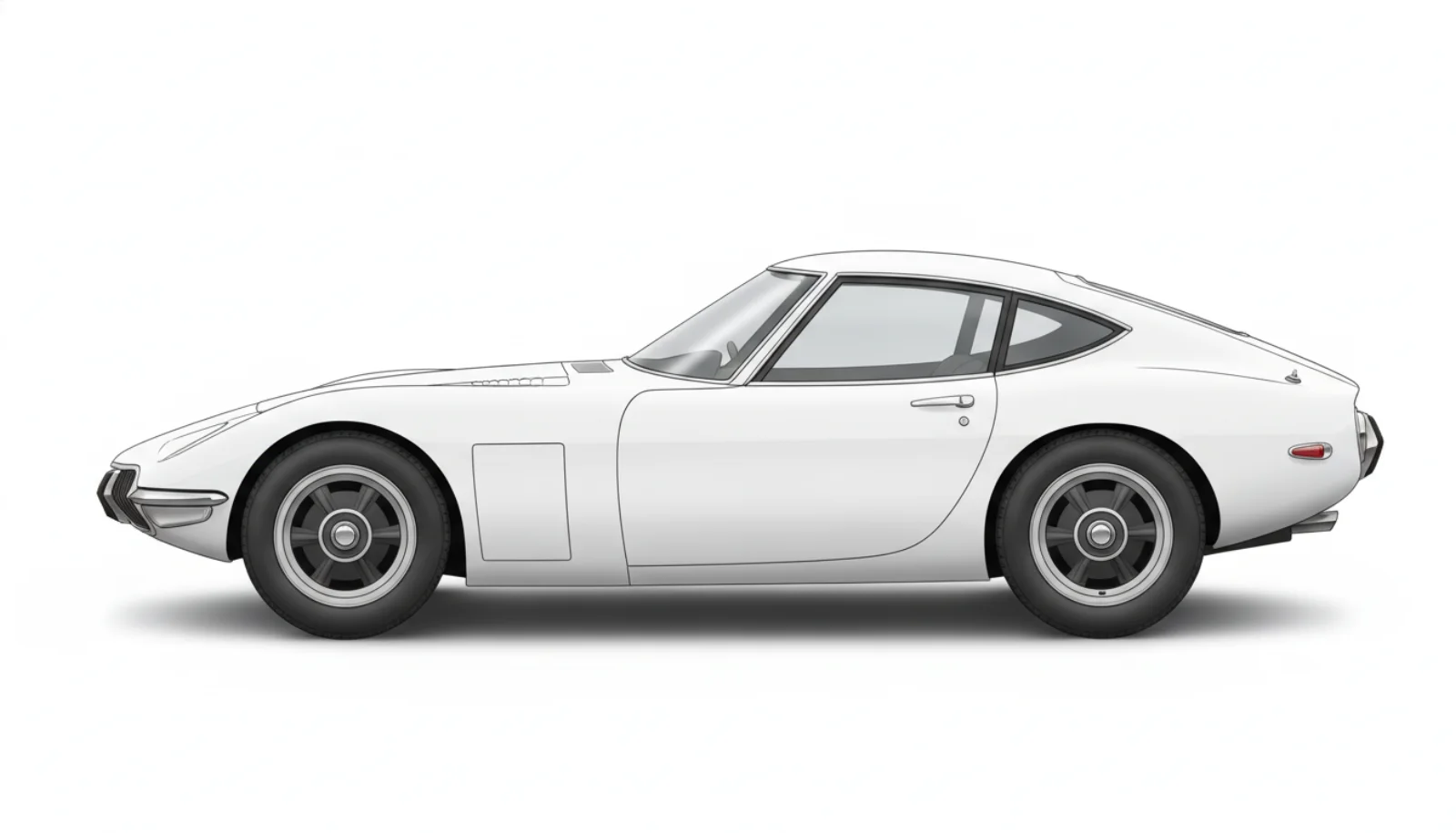
Illustrations are generated from period references and shown in the selected factory color; they are not photographs.
Where it was built
Where the cars went
- Japan, 1967–1970: Cars for the Japanese market in Toyota's breakdown of its 337: 110 early and 108 late. The same breakdown lists 102 for export, 14 special-purpose, 2 test cars and 1 unknown.
- United States, 1966–1970: From 2000gt.net's export table (2 in 1966, 51 in 1967, 1 in 1969, 4 in 1970), compiled by the site's author from several sources including unofficial exports. Hawaii is listed separately with 7 more. The production list itself shows 56 cars with a US destination plus 3 US competition cars. Wikipedia says about 60 reached North America and auction catalogues often quote 62.
- Belgium, 1967–1968: From 2000gt.net's export table, which its author compiled from several sources and which includes unofficial exports; it totals 115, the same number Yamaha gives for exports.
- Australia, 1968: From 2000gt.net's export table, which its author compiled from several sources and which includes unofficial exports; it totals 115, the same number Yamaha gives for exports.
- France, 1968: From 2000gt.net's export table, which its author compiled from several sources and which includes unofficial exports; it totals 115, the same number Yamaha gives for exports.
- Philippines, 1968: From 2000gt.net's export table, which its author compiled from several sources and which includes unofficial exports; it totals 115, the same number Yamaha gives for exports.
- United Kingdom, 1967: From 2000gt.net's export table, which its author compiled from several sources and which includes unofficial exports; it totals 115, the same number Yamaha gives for exports.
- Switzerland, 1968: From 2000gt.net's export table, which its author compiled from several sources and which includes unofficial exports; it totals 115, the same number Yamaha gives for exports.
- South Africa, 1967–1968: From 2000gt.net's export table, which its author compiled from several sources and which includes unofficial exports; it totals 115, the same number Yamaha gives for exports.
- Portugal, 1968: From 2000gt.net's export table, which its author compiled from several sources and which includes unofficial exports; it totals 115, the same number Yamaha gives for exports.
- Mozambique, 1967: From 2000gt.net's export table, which its author compiled from several sources and which includes unofficial exports; it totals 115, the same number Yamaha gives for exports.
- Denmark, 1967: From 2000gt.net's export table, which its author compiled from several sources and which includes unofficial exports; it totals 115, the same number Yamaha gives for exports.
- Ghana, 1967: From 2000gt.net's export table, which its author compiled from several sources and which includes unofficial exports; it totals 115, the same number Yamaha gives for exports.
- Kuwait, 1968: From 2000gt.net's export table, which its author compiled from several sources and which includes unofficial exports; it totals 115, the same number Yamaha gives for exports.
- Thailand, 1968: From 2000gt.net's export table, which its author compiled from several sources and which includes unofficial exports; it totals 115, the same number Yamaha gives for exports.
- El Salvador, 1970: From 2000gt.net's export table, which its author compiled from several sources and which includes unofficial exports; it totals 115, the same number Yamaha gives for exports.
- Venezuela, 1967: From 2000gt.net's export table, which its author compiled from several sources and which includes unofficial exports; it totals 115, the same number Yamaha gives for exports.
- Puerto Rico, 1967: From 2000gt.net's export table, which its author compiled from several sources and which includes unofficial exports; it totals 115, the same number Yamaha gives for exports.
- Curaçao, 1968: From 2000gt.net's export table, which its author compiled from several sources and which includes unofficial exports; it totals 115, the same number Yamaha gives for exports.
Against its rivals
Same class, same years. Each rival is shown in the specification and year a buyer would have cross-shopped.
Longer is better. Figures are for the variant and year named under each car, from the sources listed below.
In the comparison
Porsche 911 S 2.0 · 1967 · Germany
Road & Track named the 911 and 911 S as the cars the 2000GT would be priced against in the United States.
Jaguar E-Type Series 1 4.2 fixed-head coupé · 1967 · United Kingdom
The long-bonnet six-cylinder coupé the 2000GT was styled and priced against; cheaper and much faster.
Mazda Cosmo Sport 110S (L10A) · 1967 · Japan
Japan's other hand-built two-seat coupé, launched in the same month of May 1967 at a much lower price.
Datsun 240Z · 1970 · Japan
The six-cylinder Japanese coupé that reached the US market as 2000GT production ended, built in volume.
Factory options
| Option | Code | Years | Price | Built with it |
|---|---|---|---|---|
| Alternative final-drive ratios4.375:1 standard on the 2.0-litre manual car; Road & Track lists 4.111 and 4.625 as alternatives and 2000gt.net adds 4.875. | — | 1967–1970 | — | — |
| Toyoglide 3-speed automatic transmissionLate series only, model code MF10-C (type 36040), and MF12L-C on the 2.3. | — | 1969–1970 | — | 19 |
| Air conditioning (cooler)Late series. Cars so fitted have an extra intake under the grille. The number built is not documented. | — | 1969–1970 | — | — |
| Special-order paintBellatrix Yellow on early cars and one-off colours such as Magicron Yellow and Patrol White appear in the production list. | — | 1967–1970 | — | — |
Known issues
Hand-fitted body panels are not interchangeable
1967–1970moderateYamaha's Yasukawa (安川力), who was responsible for the build, is quoted on Japanese Wikipedia explaining that the steel panels were hand-finished by sheet-metal workers and matched to each body so that the compound-curved glass would sit flush. As a result every car differs in detail and a replacement panel will not simply bolt on.
Fix Body repairs need a restorer who will fit and shape panels to the individual car. Toyota now reproduces some mechanical parts for owners through its GR Heritage Parts programme.
Cabin too small for tall drivers
1967–1970minorThe roof is 1,160 mm from the ground and the cabin was laid out for occupants of about 160 to 190 cm. Sean Connery reportedly did not fit and could not be filmed in the coupé, which is why the Bond cars lost their roofs, and Japanese Wikipedia notes that people in the upper 180s find it cramped.
Pulls to the right under hard acceleration (pre-production test car)
1967minorRoad & Track's June 1967 test of a pre-production car reported a slight tendency to veer right under acceleration, even when moderate, and a first-gear rev limit that arrived early. Whether series cars behaved the same way is not documented.
How it was advertised
The 2000GT was built in tiny numbers (about 60 reached North America) and served mainly as a halo for Toyota, so it was promoted through events and borrowed prestige more than through product advertising. It was first shown at the 1965 Tokyo Motor Show; in October 1966 Toyota staged a 72-hour record run at the Yatabe high-speed test track, published with its own Speed Trial programme, in which a 2000GT set FIA world and international speed and endurance records; it raced in Japan, winning the 1967 Fuji 24 Hours; and two open cars were built for the 1967 James Bond film You Only Live Twice, which gave the car its widest exposure, including in the film's printed publicity abroad. Carroll Shelby ran a pair in US SCCA production racing in 1968.
Toyota's American advertising in 1967 used the 2000GT to change what the brand stood for. A full-page ad in Life led with Road & Track's verdict that it was one of the most exciting and enjoyable cars the magazine had driven; trade-oriented pages in enthusiast magazines called the car "news", recited the record run, and then turned to Toyota's export growth and its affordable Corona. In Japan the car was sold through dark, luxurious catalogues and leaflets. No agency or television advertising was documented.
Where it ran: 6 documented placements
More advertisements, viewable at their source (6)
These are still under copyright, so we describe them and link to where they can be seen rather than reproduce them.
- 1966Toyota 2000GT Speed Trialbrochure · 1966-10 · Internet Archive (Car Brochures & Adverts collection) ↗Cover of the programme and rules booklet for the international and world endurance speed record attempt at Yatabe from 1 to 4 October 1966: a yellow-and-green record car on the banking under bold "Speed Trial" lettering, with the JAF sanction mark. Published by Toyota Motor Co.
- 1967Toyota 2000GT cataloguecatalog · Internet Archive (Car Brochures & Adverts collection) ↗Japanese-market sales catalogue with an all-black, leather-grained cover carrying only a small red Toyota 2000GT triangle badge.
- 1967"...The Toyota 2000GT is one of the most exciting and enjoyable cars we've driven." —Road & Trackmagazine · Life · 1967-06-26 · Internet Archive (Car Brochures & Adverts collection) ↗A grainy photograph of the 2000GT cornering hard on a banked track fills the page; the copy, set on a slant, presents the record run and Toyota's entry into international competition, borrows Road & Track's praise as the headline, and nods to the James Bond film.
- 1967This car is news.magazine · 1967-07 · Internet Archive (Car Brochures & Adverts collection) ↗A crowd of men leaning over a 2000GT at a motor show; the copy recounts the record run equal to half way round the world, then pivots to Toyota's exports to 80 countries, its rank among world producers, and the Crown and Corona.
- 1967Look who's talking like a champion. Toyotamagazine · Car and Driver · 1967-07 · Car and Driver (via AOL) ↗Half-page ad set into the editorial page: a dark 2000GT coupe above a Corona sedan. The 2000GT is billed as soon to be imported and already a record holder; the $1,760 Corona is pitched on Toyota's rapid rise in US import sales. Placed by Toyota Motor Sales U.S.A. of Torrance, California.
- 1967James Bond 007: Man lebt nur zweimal / You only live twice / On ne vit que deux foisother · Internet Archive (Car Brochures & Adverts collection) ↗Trilingual German film-publicity insert with a still of Sean Connery climbing out of the white open 2000GT built for the film. Film publicity rather than a Toyota advertisement, but the car's most widely seen promotion.
No 2000GT advertisement or brochure with a public-domain or open licence was found on Wikimedia Commons; the Internet Archive items were uploaded by a collectors' group without any licence statement, so all entries are link-only. The 1967 Car and Driver ad claims 16 international and world speed records; Wikipedia gives 13 FIA world records from the 1966 Yatabe run, and the "This car is news" ad says 3 world and 13 international class records. The figures count different things; not resolved. "This car is news" carries a July 1967 folio and a reader-service number but no magazine name. An Internet Archive item titled "Toyota 2000GT Ad. Japan" is in fact a poster for a modern documentary film, not a period ad, and is excluded. Japanese leaflets for 1968 and 1969 and a 1970 catalogue also exist in the same collection but were not opened.
Sources
- 1Toyota 2000GT (MF10), Vehicle Lineage, 75 Years of Toyota — Toyota Motor Corporation factory
- 275 Years of Toyota, Part 2, Chapter 1, Section 3: Development and Sales of New Models — Toyota Motor Corporation factory
- 32000GT (archive story 852) — Toyota Automobile Museum factory
- 4Toyota 2000GT (1967), Communication Plaza collection — Yamaha Motor Co., Ltd. factory
- 5Production: liste (simplified Yamaha production list as published by Shin Yoshikawa, chassis by chassis) — 2000gt.net registry
- 6Production: exportations (exports by country and year) — 2000gt.net registry
- 7Production: fabrication (build, prices, colour palette) — 2000gt.net reference
- 8Fiche technique (MF10 1967, MF10 1969, MF12 1969) — 2000gt.net reference
- 9Collections: par numéro (individual chassis histories) — 2000gt.net registry
- 10Road & Track, June 1967 (20th anniversary issue): Toyota 2000 GT road test and technical analysis, French translation — Road & Track, as translated at 2000gt.net period-test
- 11James Bond 007: réalisation des 2000GT spider; le mystère des spiders — 2000gt.net reference
- 12Technique: intérieur — 2000gt.net reference
- 13Shelby-American Racing (SCCA) — 2000gt.net reference
- 14トヨタ・2000GT — Wikipedia (Japanese) reference
- 15Toyota 2000GT — Wikipedia reference
- 161968 Toyota 2000GT, chassis MF10L-10189, Amelia Island 2015, lot 193 — RM Sotheby's auction
- 17Toyota 2000GT (1967), classic car archive — AutoZine reference
- 18Porsche 911 (classic) — Wikipedia reference
- 19Jaguar E-Type — Wikipedia reference
- 20Mazda Cosmo — Wikipedia reference
- 21Nissan Fairlady Z (S30) — Wikipedia reference
Research notes: what is not documented, and where sources disagree (13)
- Production total: two figures are both correct for what they count. Toyota, the Toyota Automobile Museum and Yamaha all publish 337 for the 2.0-litre car (Yamaha: including 115 for export), and Japanese Wikipedia says the nine 2.3-litre MF12L are outside that figure. The Yamaha production list published by Shin Yoshikawa, as reproduced chassis by chassis at 2000gt.net, has 351 entries with build data: 233 early cars, 109 late cars and 9 MF12L. This dossier uses 351 because it is the registry-level count and the one RM Sotheby's and others quote. Why Toyota's 337 is five lower than the list's 342 2.0-litre cars is not documented.
- The 233 / 109 / 9 split is widely repeated (English Wikipedia, Conceptcarz) as 233 MF10, 109 MF10L and 9 MF12L. In the production list those numbers are the early series, the late series and the MF12L. The list labels only 86 cars MF10L (85 early, 1 late). This looks like a long-standing misreading and is worth a human look against Yoshikawa's book, which was not available to open.
- Left- and right-hand drive: RM Sotheby's states 84 left-hand-drive cars. The list agrees if 10081 and 10082 (labelled MF10L but carrying the right-hand-drive type code 36010) are treated as right-hand drive: 83 cars with type code 36011 plus MF10L-10487. driveSide.lhd is 84 plus the nine MF12L, which Japanese Wikipedia says were all left-hand drive; driveSide.rhd is the remaining 258, which matches a count of the list (148 early MF10, 108 late MF10 and MF10-C, plus 10081 and 10082). Other published left-hand-drive figures are 62 (usually meaning US-market cars), about 70 and 109; none could be traced to a primary record.
- Every per-colour, per-year and per-type count in this dossier was tallied for this research from the 2000gt.net reproduction of the production list, not printed as a total by the source. Seven early cars have no colour recorded (10003, 10005, 10006, 10007, 10009, 10012 and 10159), so the colour counts add up to 344, not 351. The year counts use the date column of that list, which the site does not define; it reads as a completion or shipping date.
- Factory paint codes for the 2000GT colours could not be found in any source opened, so no colour has a code.
- Exports: Toyota's breakdown on Japanese Wikipedia gives 102 cars for export out of 337; Yamaha says 115; 2000gt.net's table by country also totals 115 but its author says it mixes official and unofficial exports, and it does not match the destination column of the production list in every case (Hawaii is 7 in the table and 1 in the list; the list has 56 US destinations plus 3 competition cars against the table's 58). The per-country figures in markets are from the table and are marked estimated. The table's United Kingdom and Venezuela rows have no matching destination in the list.
- US price: Road & Track estimated 6,800 dollars in June 1967; English Wikipedia gives about 7,150 dollars for 1968 citing Hagerty (page could not be opened); 2000gt.net says 7,230 dollars. Japanese price: Yamaha and Japanese Wikipedia give 2,380,000 yen, 2000gt.net 2,373,000 yen.
- Performance: the only period test found is Road & Track's of a pre-production car (0-60 mph 10.0 s, 128 mph), and its data panel was read through AutoZine's summary because the translated article at 2000gt.net does not reproduce the figures. topSpeedMph for the early car is Toyota's own 220 km/h. The late-series and MF12L top speeds and weights are from 2000gt.net's data sheet (215 and 205 km/h; 1,145 and 1,165 kg), which does not say where they come from.
- End of production: English and Japanese Wikipedia give August 1970 as the end of the production run, while Japanese Wikipedia elsewhere dates late-series production to October 1970; the production list's last dates are 27 October 1970 and 2000gt.net says the car was dropped at the end of October 1970. Toyota's own pages say only 1970.
- Yatabe trial: Toyota's corporate history says 78 hours, 16,000 km and 206.1 km/h; the museum page and English Wikipedia describe a 72-hour trial. Both give three world and 13 international records.
- The Bond cars: Toyota and its museum say two prototypes were converted, one for filming and one spare; 2000gt.net's detailed account says they were pre-production cars without chassis numbers, converted in about two weeks in May and June 1966. They are recorded as a body style with 2 units but are not included in the 351. The museum says the shooting with the car took place in September 1966; 2000gt.net dates the press presentation of the finished car to 7 July 1966.
- Known issues: no owners' club buyer's guide or registry note on rust or mechanical weak points could be opened, so knownIssues is thin and limited to what the sources above actually say.
- Hagerty, Hemmings and Curbside Classic pages on the car returned errors and were not read. Toyota GB's history page returned 404.
21 sources. Paint swatches are screen approximations of the factory colors.